Manchester Pest Solutions treats wasp nests at homes in Bramhall and Hazel Grove, including the Dairyground and Parkside estates and gardens beside Bramall Park. We confirm they're wasps, not bees, dust the entrance from the ground with a long lance and show you where children and pets should keep clear. Phone or message us to book.
What draws wasps to gardens here?
A wasp colony is built from chewed wood and fed on insects, and Bramhall and Hazel Grove have plenty of both close at hand. Bramall Park combines woodland, open grassland and man-made ponds with two streams, the Ladybrook and Carr Brook. Happy Valley, the nature reserve off Bridge Lane, adds old woodland, marshy ground and more ponds, with the Lady Brook running through it. Over in Hazel Grove, Torkington Park has its formal flower garden and secret garden. A queen settling in a garden on the edge of any of these has fence posts and fallen branches for paper, and a steady supply of flies and caterpillars to chew up for her grubs.
Where do the nests end up?
Mostly it depends on how old the house is.
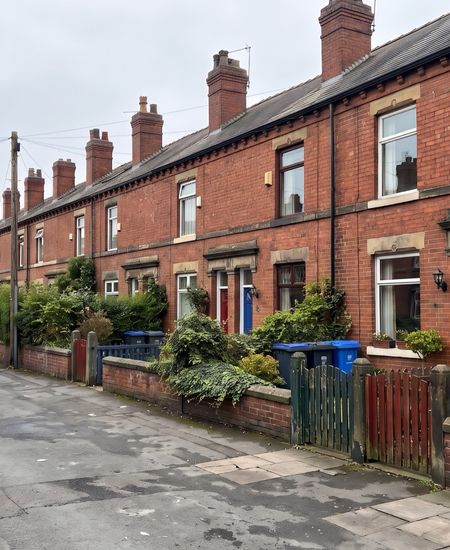
Around Bramhall village and along the main roads, the Edwardian and Victorian houses have the oldest roofs we work on locally. A queen will use a lifted tile, a gap behind a timber bargeboard or worn pointing under the gutter, and the nest often ends up in the loft or in the narrow void above a bay. Because many of these roofs are high and steep, we spend a few minutes watching the flight line before we decide where to treat.
On the estates built in the 1960s and early 1970s, Parkside and New House Farm in the north and Dairyground and Little Australia nearer the centre, the weak point is usually the eaves. Soffit and fascia boards of that age split, shrink or come away at the joints, and a small gap at the corner of a soffit leads straight into a warm loft.
Hazel Grove’s detached and semi-detached family homes get nests in all the usual places, eaves, airbricks and roof spaces, with sheds and bird boxes in the garden close behind. Newer homes, such as the Melford Road scheme or Woodford Garden Village next door, have fewer gaps in the brickwork, so nests there more often turn up in vents, under decking or in a shed.
How does a wasp visit run in Bramhall and Hazel Grove?
Send us a photo of the entrance taken from well back, and tell us roughly how high it is and whether anyone at home reacts badly to stings. That lets us rule out bees before we set off, and we’ll offer the earliest slot we have, often the same day.
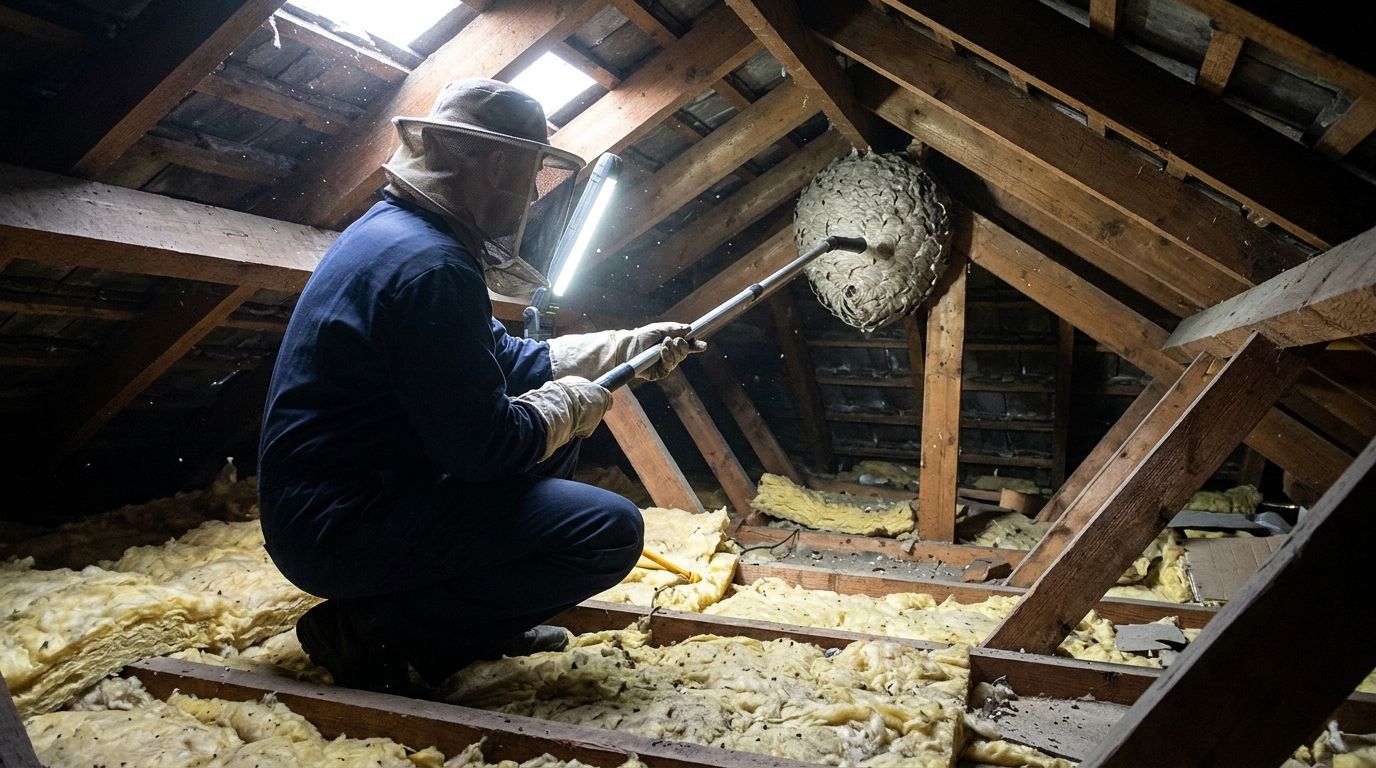
On the day we watch first, then puff a small amount of approved insecticidal dust into the entrance, normally from the ground with an extension lance, and the wasps carry it into the nest themselves. Expect a busy few hours at the hole and a quiet one within a day or two. One visit is enough for most jobs; if the traffic hasn’t dropped after a couple of days, let us know and we’ll come back.
Ponds, pets and children in the garden
If your garden has a pond, or backs onto the Ladybrook or one of Bramall Park’s streams, tell us when you book. Insecticides are harmful to fish and other pond life, so we’ll keep the dust well away from the water. While we treat, children and pets are best kept inside, with the windows on that side closed. Afterwards, keep everyone off the treated spot until the next day, and keep cats in that evening if you can, because a warm sill next to a nest is exactly where they like to sit.
Should I call the council instead?
Many councils run a pest control service for residents, but what is covered, who can book and the charges all vary and can change, so check the council’s own pest control pages before you book. If you rent, report the problem to your landlord first. If you would rather book a private firm, call or message us and we’ll offer the earliest slot we have.
How do I stop a nest next spring?
As we write, at the end of October, this year’s colonies are finishing: the workers are dying off and the new queens have gone to hibernate. An old nest is never reused, so winter is the time to close the gap they used, whether that means re-fixing a soffit board, refitting a tile or putting mesh over a vent. From April, look over sheds, summerhouses and bird boxes every week or two, while any new nest is still tiny. In late summer, pick up windfall apples and plums from older fruit trees and keep bin lids shut.
What we tend to find in Bramhall & Hazel Grove
- Gardens that back onto Bramall Park or Happy Valley sit beside woodland, ponds and the Ladybrook, so a queen nesting there has dead wood for paper and plenty of insects for her grubs within a short flight.
- On the 1960s and early 1970s estates, including Dairyground, Little Australia, Parkside and New House Farm, soffits and fascias are now about half a century old and a split or shrunken board is a common way in.
- The Edwardian and Victorian houses near Bramhall village and along its main roads carry the oldest roofs in the area, where a lifted tile, a gap behind a bargeboard or tired pointing at the eaves is often all a queen needs.
- In the Bramhall Lane South Conservation Area, tree work needs six weeks' notice, so a nest in a garden tree is treated through its entrance and left in place rather than cut out.
What happens when you call us
- 1
Tell us what you're seeing
Where the wasps are flying in, roughly how high it is, and whether anyone at home is allergic to stings. A photo of the entrance from a safe distance helps us check it's wasps, not bees.
- 2
Finding the way in
We watch the flight line first, because where you see wasps isn't always where they go in. It might be a slipped slate, a split soffit, an airbrick or a hole in the lawn.
- 3
Treating the nest
An approved insecticidal dust goes into the entrance, usually with an extension lance from the ground. Wasps walking in and out carry it deep into the nest for us.
- 4
Aftercare, in plain English
Before we leave we show you where we've treated, which windows to keep shut, and where children and pets should steer clear of until the next day.
- 5
Checking it's worked
Wasps stay busy for a few hours, then tail off over a day or two. If they're still flying in steadily after that, let us know and we'll come back for a look.
- 6
Taking the nest away, if it's in the way
Dead nests are never reused, so most are left in place. If one is in a shed, garage or bird box you use, we can remove it once it has gone quiet.
Wasp Nest Removal in Bramhall & Hazel Grove: your questions
Our garden backs onto Happy Valley and the wasps seem to come from the reserve side. Can you treat them?
If the nest is on your property, in a hedge, fence post, shed or the house itself, yes. If it turns out to be on the reserve, that's council parkland, so we won't treat it without the landowner's agreement; let Stockport Council know where it is. Happy Valley's grassland and woodland suit bumblebees as well as wasps, so watch how they fly before calling: wasps dart straight in and out of one small gap, while bumblebees bumble. Keep doors and windows on that side shut in the meantime.
There's a nest in an old tree in our garden on Bramhall Lane South. Will the tree have to be cut?
No. The dust goes into the entrance hole, so the tree isn't touched, and once the colony has died the empty nest can stay where it is. That matters here, because the conservation area rules mean most pruning or felling needs six weeks' notice to Stockport Council first. If the branch needs cutting back for another reason, such as squirrels getting onto the roof, send that notice in winter, when the nest is long dead and nobody will be stung while the work is done.
We've moved into one of the new homes at Melford Road. How are wasps getting into a brand-new house?
New houses are tighter than old ones, but not sealed. The usual gaps are round extractor and boiler flues, where pipes and cables leave the wall, at the ends of the roof where verge caps have lifted, and through vents that never had mesh fitted. In the garden, new sheds, fence panels and freshly laid decking give a queen easy shelter. If the gap is a building defect, add it to your snagging list for the developer once we've dealt with the nest.
We've found two nests, one in the eaves and one in the shed. Can you do both on one visit?
Usually, yes, as long as both entrances can be reached safely. Two nests in one garden isn't unusual in late summer, particularly in larger plots near woodland, because one queen's success doesn't stop another settling a few metres away. If you were weighing up the council instead, note that its reduced rate for households on certain benefits doesn't cover a second wasp nest. Before either is treated, check neither is a bumblebee nest, since bumblebees are often left alone and the council doesn't treat bees at all.
Can I get a wasp nest removed for free in Manchester?
Usually not. Councils have no legal duty to deal with wasps, so it comes down to what each one chooses to offer. Check Manchester City Council's website for current pest control services and charges. Check your council's website for current pest control services and charges. Its website sets out the current pest list and booking conditions, so read those before you book. Other Greater Manchester councils set their own rules, and housing association tenants should ask their landlord first.
Can I just leave the nest until winter?
Often, yes. If the nest is somewhere nobody goes, such as high on a gable or at the bottom of a big garden, it will die off on its own once the frosts arrive, and wasps never reuse an old nest. It's worth treating if the entrance is next to a back door, a window you open, a path, a pram or a play area, or if anyone at home is allergic. Remember that wasps get more bad-tempered in late summer, so a nest that's tolerable in June can be a real nuisance by September.
How do I know if it's wasps or bees?
Wasps are bright yellow and black, smooth and shiny, with a narrow waist, and they fly straight in and out of a small gap. Bumblebees are round and furry; the tree bumblebee, with a ginger body, black middle and white tail, loves bird boxes and eaves. Honeybees are slimmer, golden brown and slightly fuzzy, and a swarm hanging from a branch is almost always honeybees. We don't routinely treat bees. Send us a photo if you're unsure, and see our bees and bumblebees page for what to do instead.
More help in Bramhall & Hazel Grove
Last updated: