Manchester Pest Solutions helps small businesses across Manchester and Greater Manchester, from cafés, takeaways, shops and salons to small offices and landlords with flats above shops. We'll offer the earliest slot we have, often the same day, try to fit round your opening hours and leave a written report for your records. Call or message us to book.
What are the first signs of pests in a shop, café or salon?
Usually it’s something small that doesn’t add up. Droppings along the back of a shelf or in the cupboard under the till. A nibbled corner on a box of napkins or a split bag of flour. Dark, greasy marks along the bottom of a wall where a mouse or rat has run the same route night after night. Mouse droppings are about the size of a grain of rice; rat droppings are chunkier, a centimetre or more long.
In kitchens and takeaways, a musty smell and small brown insects darting behind the fridge or dishwasher when the lights go on point to cockroaches. Elsewhere, look for scratching in the ceiling or behind panelling after you’ve locked up, chewed cables, holes torn in rubbish bags in the yard, tiny moths or beetles in dried stock, and pigeon mess building up on your sign or window ledge.
Ask whoever opens up and whoever closes. They’re the ones who see a mouse cross the floor when the shop is quiet.
Why do Manchester businesses get pests?
A lot of Manchester’s trade happens in older buildings: parades with a flat upstairs, a cellar below and ceiling voids that aren’t always sealed off from next door. Mice don’t respect the party wall. If the unit three doors down has a problem, a gap in a shared void can give them an easy walk into your stockroom.
Food waste is the other draw. In the Northern Quarter, trade waste often goes out as bags on the pavement, and the council has prosecuted at least one venue over waste left in a way that can attract vermin. On the Curry Mile in Rusholme, with at least 70 restaurants, takeaways and kebab houses on one stretch of Wilmslow Road, the bins hardly get a night off. The café and bar strips on Beech Road in Chorlton and Burton Road in West Didsbury see the same thing on a smaller scale: deliveries, cardboard and food waste gathering at the back door.
Then there’s the city itself. Rats use the Irwell, the Rochdale Canal through the city centre, and the Bridgewater Canal at Castlefield as quiet corridors, and building work across the city disturbs them from drains and old foundations. Mice and rats also push indoors as the weather turns in autumn. Council figures covered by the local press showed reports of rat infestations more than doubling between 2015 and 2019, with the Northern Quarter among the worst hit. Figures a national pest firm published in October 2026 put the year-on-year rise in Manchester rodent inquiries at 26%, the biggest of the cities it named. That’s one company’s numbers, not an official count.
What happens when you call us?
You tell us what you’ve seen, and we ask whether you handle food, when you’re open and whether anyone lives upstairs. We’ll offer the earliest slot we have, often the same day, and try to fit round your trading, before you open or after the last customer leaves.
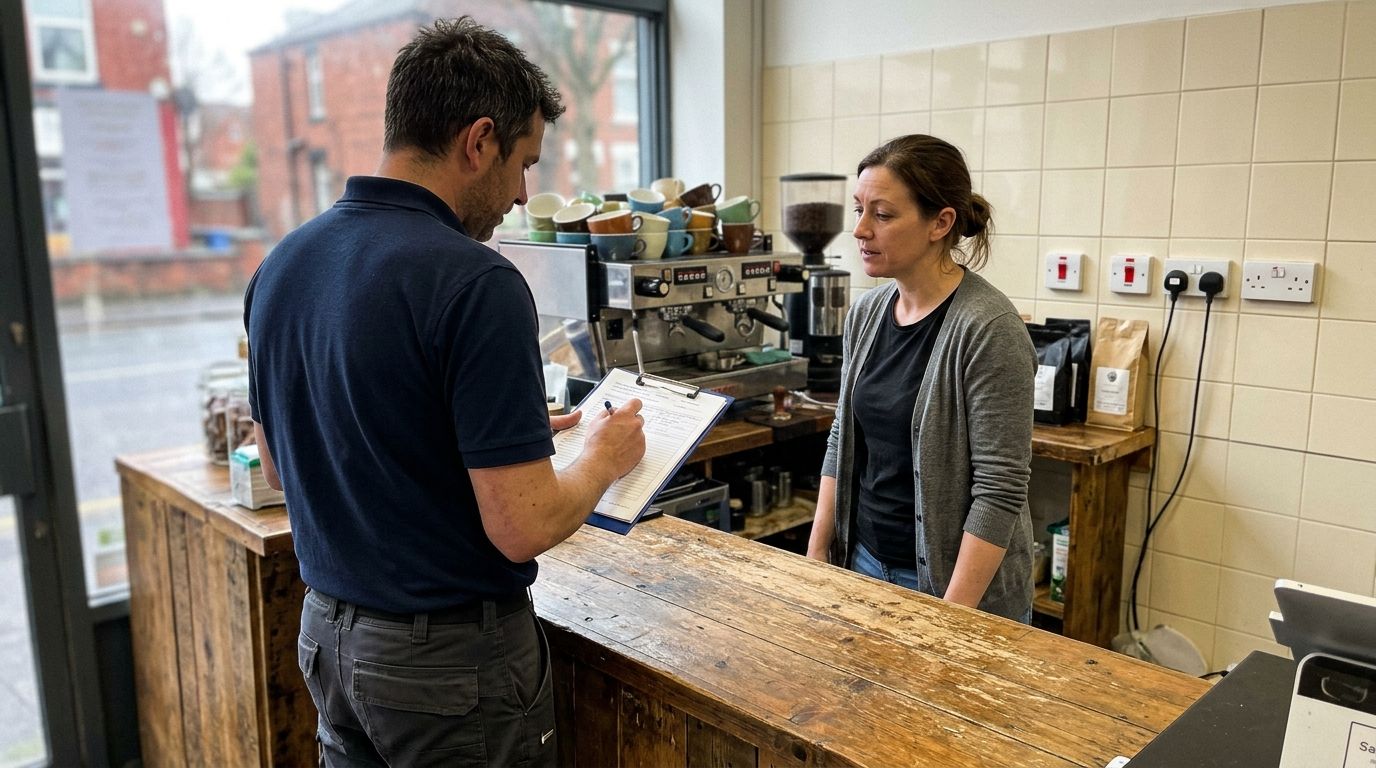
On the first visit we look round properly, front of house and back, to work out which pest it is, how settled it is and, most importantly, how it’s getting in. We’ll explain what we’ve found in plain English before we do anything.
Treatment depends on the pest. For mice and rats it’s usually traps, rodenticide in locked boxes, or a mix of both, placed along the routes they use. For cockroaches we use gel baits worked into the cracks, hinges and warm gaps near fridge and dishwasher motors where they hide, with monitors to show whether numbers are falling. For flies, moths or beetles in stock, finding and clearing the source matters more than any spray. Where we can, we’ll seal gaps on the same visit. Before we leave you get a written report covering what we found, what we used, where it is and what we need you to do.
Is it safe for staff, customers, children and pets?
Plenty of small businesses have children coming in after school, a dog by the till or staff who are pregnant, so we ask about all of that before we start. Any rodent bait goes in locked, tamper-resistant boxes fixed in place, away from open food and out of the areas customers use. Insect gels go into cracks and crevices, not on worktops, and we choose products that are suitable for use in food rooms.
We follow the UK rodenticide stewardship approach backed by CRRU UK, which means thinking about trapping and proofing first, using poison only for as long as it’s needed, checking for dead rodents and removing the bait at the end. You’ll know exactly where everything is, and we’ll tell you what to do if a box gets knocked or moved.
How many visits will it take?
For mice, it’s usually two or three visits over a couple of weeks. Rats need checking more often at the start, then roughly weekly until the bait stays untouched and the signs stop. Cockroaches take longer, often several visits over a month or more, because their egg cases aren’t affected by the first treatment, so young ones keep hatching for a while and need dealing with too. Flies and stored-product insects can sometimes be sorted in one visit once the source is cleared.
After that, it’s your choice. A non-food shop may never need us again once the gaps are closed. Many cafés and takeaways prefer routine checks through the year, set by how much risk the business carries.
How do you stop pests coming back to your premises?
Proofing matters most. A mouse can get through a gap about the width of a pencil, so we look at pipe and cable holes, the bottom of back doors, broken airbricks and the voids behind kitchen kickboards. Bristle strips, mesh, steel wool and sealant close most of them. If rats are coming up through a broken drain, you’ll need a drainage contractor as well, and we’ll tell you if that’s the case.
Housekeeping does the rest. Keep trade waste in lidded bins and get it collected rather than leaving bags out overnight. Under the government’s Simpler Recycling rules, workplaces in England with ten or more full-time equivalent employees already have to separate food waste, and smaller firms are due to follow by 31 March 2027 on the current timetable, so keep caddies lidded and empty them often. Flatten and remove cardboard, which mice love for nesting, check deliveries as they come in, and clean behind and under equipment rather than round it. If pigeons are fouling your shopfront, our pigeon proofing work can help there too.
When does DIY stop being enough?
A single mouse in a clothes shop might be solved with a couple of well-placed snap traps. Beyond that, DIY tends to go wrong in predictable ways. Supermarket sprays scatter cockroaches deeper into the walls. Poison scattered behind a fridge is a contamination risk, and an inspector will ask why it’s there. Rats that die in a ceiling void leave a smell that can last for weeks.
Don’t reach for glue traps either. Since 31 July 2024, setting one for a rodent in England has been an offence without a licence, and an ordinary shop, café or takeaway is very unlikely to get one.
Call us when there are droppings anywhere near food, when you see cockroaches at all, when it’s rats, when the problem keeps coming back, or when you’ve got an inspection coming up.
Who’s responsible, and what should you keep on file?
If you run a food business, food hygiene law requires adequate procedures to control pests. That duty comes from the hygiene rules enforced in England through the Food Safety and Hygiene (England) Regulations 2013, alongside the Food Safety Act 1990, and it stays with you even when you pay a pest controller. Keep every report, plan and invoice with your Safer Food, Better Business pack or HACCP records, because that’s what shows an environmental health officer you’re on top of it.
The Prevention of Damage by Pests Act 1949 also expects occupiers to tell the council in writing if they know rats or mice are living on or visiting their land in substantial numbers, and it lets the council require work to deal with them. How that applies depends on the circumstances, so ask us or the council’s environmental health team if you’re not sure. For any employer, workplace health and safety law expects clean, hygienic premises, and that includes keeping rats and mice out of staff areas.
If you rent your unit, your lease decides who fixes what. If you let a flat above, residential law applies to that home, and our domestic pest control page explains how that usually works for landlords and tenants.
What happens when you call us
- 1
Tell us what you've seen
Ring or message us with what you've found and where. We'll ask what the business does, when you're open and whether there's a flat upstairs, then find you the earliest slot we have.
- 2
A proper look round
We check the shop floor, kitchen, stockroom, toilets, cellar, yard and bins, looking for droppings, gnawing, smear marks and the gaps pests are using to get in from next door or outside.
- 3
Treatment that suits a working premises
Traps, locked bait boxes or insect gels, chosen for where food is handled and where customers walk, placed out of reach and marked on a simple plan so staff know what not to move.
- 4
Blocking the way in
We seal gaps round pipes, under doors and behind kickboards there and then where we can, and tell you plainly about anything that's a job for your landlord or a builder.
- 5
Follow-up and a written report
We come back to check activity has stopped, take away anything no longer needed and leave a report you can keep with your food safety pack or premises file.
- 6
Regular checks if you want them
For cafés, takeaways and other food businesses, we can set up routine visits through the year so small problems are caught before a customer or an inspector spots them.
How many visits? Most one-off problems take a few visits over two to four weeks: a survey and treatment, then follow-up checks, which come closer together at the start where bait is used. Cockroaches often need longer. Food businesses may also choose routine checks through the year.
Commercial Pest Control: questions people ask us
Do you only deal with homes, or will you come to my shop or café?
We're a homes-first company, but small businesses get exactly the same service from us. We'll happily come to a café, takeaway, corner shop, salon, barber's, small office or the flat above, and you'll get the same plain talk and the same care around children and pets. If your site needs a large multi-site contract with audit-heavy reporting, we'll tell you honestly whether we're the right fit. For most small premises in Manchester and Greater Manchester, we are.
We've seen a mouse in the kitchen. Could the council close us down?
A single mouse that's dealt with promptly is unlikely to close you, but it does need action straight away. Environmental health officers look at whether pests are under control and whether you're managing the risk. If they find an active infestation they can serve a hygiene improvement notice setting out what has to be done, and where there's an imminent risk to health they can close the premises until it's put right. Signs of pests can also pull down your food hygiene rating. Ring us as soon as you see it and keep every report we give you.
Do we have to close while you treat?
Usually not. Most mouse, rat and cockroach work is done with traps, bait boxes and gels placed out of sight, so you can carry on trading. We'll try to come before you open or after you close, especially when we're working in a kitchen. If a room needs to be empty for a while, for example for a spray treatment, we'll tell you beforehand how long for. The exception is a serious infestation in a food area, where pausing food preparation until it's under control is often the safer call.
Is rat poison safe where customers and their dogs come in?
It can be, if it's handled the right way. Where we use rodenticide, it goes in locked, tamper-resistant boxes fixed in place, kept out of customer areas and away from open food. We work to the UK rodenticide stewardship rules promoted by CRRU UK: consider trapping and proofing first, use bait only for as long as it's needed, look for and remove dead rodents, and take the bait away at the end. You'll get a plan showing where every box is.
Can I just put glue traps down in the stockroom?
No. Since 31 July 2024 it has been an offence in England to set a glue trap to catch a rodent without a licence. Licences are only for professional pest controllers who can show they're suitably trained, and only in exceptional circumstances where there's a serious risk to public health or safety and nothing else will work. In practice, an ordinary shop, café or takeaway is very unlikely to qualify. Glue traps also cause animals a great deal of suffering. Covered snap traps or a proper treatment are the lawful way to go.
I rent my shop unit. Is pest control my job or my landlord's?
It depends on your lease, so dig it out first. Many commercial leases put repairs and pest control inside the unit on the tenant, while the landlord keeps the shared areas, roof or main structure. If mice are coming in through a broken airbrick, a gap in a shared wall or a damaged drain, the repair may fall to the landlord or a neighbour. Tell your landlord in writing, send photos and our report, and keep copies. Whoever pays for the repair, food law still expects you to keep pests out of your business.
I let the flat above my shop. Who deals with mice getting in up there?
Often you, as the landlord, particularly if they're getting in through the building. For most residential tenancies, section 11 of the Landlord and Tenant Act 1985 makes the landlord responsible for repairing the structure and exterior, pests are one of the hazards councils can assess under the Housing Health and Safety Rating System, and the Homes (Fitness for Human Habitation) Act 2018 gives tenants a route to act if a home isn't fit to live in. If the problem comes from how the flat is kept, the position can differ. Treating shop and flat together usually works best.
Do I need a pest control contract, or can I call when something goes wrong?
No law says you must have a contract. A food business must have adequate procedures to control pests, and for many cafés and takeaways regular inspections are the simplest way to show that. A clothes shop, barber's or small office may be fine calling us when there's a problem and keeping on top of bins and proofing in between. Bear in mind that paying someone to check for pests never moves the legal duty off your shoulders. We'll talk it through and suggest what genuinely fits your premises.
What affects the cost of pest control for a small business?
We'll give you a clear quote before we start. The main things that shape it are the pest involved, the size and layout of the premises, how settled the problem is, how many visits it takes and how much proofing is needed to stop it coming back. Access matters too, such as a cellar, a ceiling void or a shared yard. Routine visits through the year are quoted differently from a one-off job. We don't list prices here because two takeaways on the same street can need very different work.
Commercial near you
- Manchester City Centre
- Rusholme & Moss Side
- Longsight
- Chorlton
- Didsbury
- Fallowfield
- Levenshulme
- Salford
- Stockport
- Bury
- Cheadle & Cheadle Hulme
- Eccles & Swinton
- The Heatons
- Prestwich & Whitefield
- Sale
- Stretford
- Urmston
- Withington
- Wythenshawe & Northenden
- Ashton-under-Lyne
- Bramhall & Hazel Grove
- North Manchester (Blackley, Moston & Harpurhey)
Last updated: