Manchester Pest Solutions treats wasp nests in homes, flats and small shops across Manchester and Greater Manchester. We'll offer the earliest slot we have, often the same day. We check it isn't bees, treat the entrance and explain how to keep children and pets safe. Most go quiet within a day or two. Call or message us to book.
How can I tell it’s a nest and not just a few wasps?
A few wasps round the bins in August are just wasps being wasps. A nest gives itself away with traffic: a steady line of them using the same spot, over and over, on a warm afternoon. Stand back and watch the eaves, the bottom row of roof tiles, the airbricks and the corners of the soffits. If wasps keep landing at one point and vanishing, the nest is behind it.
Other clues:
- a faint papery crackle inside a wall or ceiling, which is wasps chewing as they build;
- wasps in the same bedroom every day, often a sign of a nest in the loft above;
- a grey, papery ball in a shed, bird box or compost bin, golf-ball sized in spring and as big as a football by late summer;
- wasps coming and going from a hole in the lawn, often an old mouse hole.
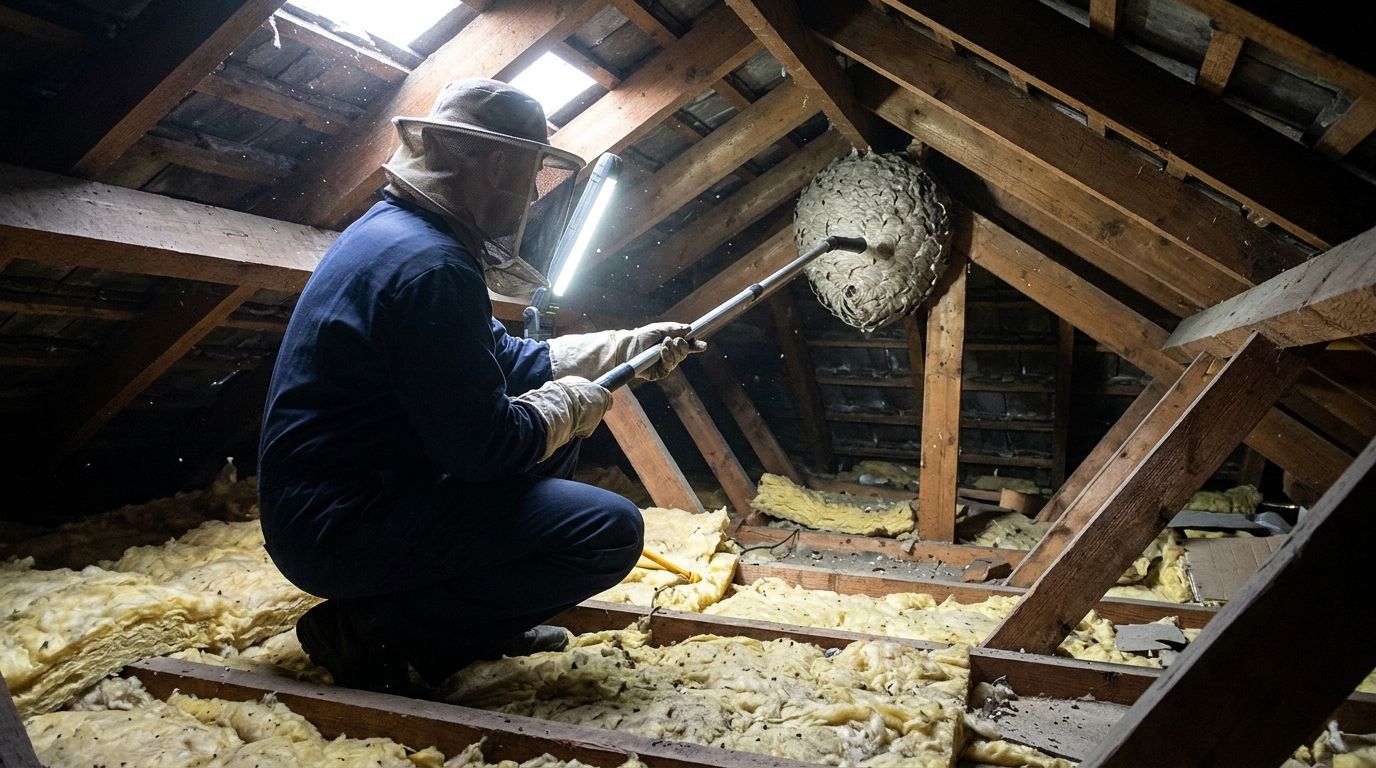
If you find one in the loft, close the hatch gently and give us a ring.
Why do wasps pick Manchester houses?
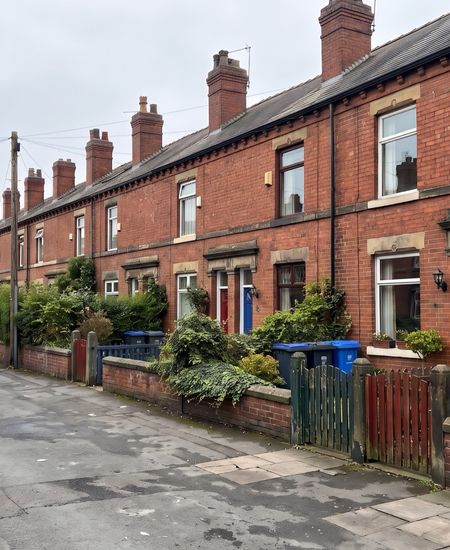
A queen that has spent the winter tucked up somewhere sheltered wakes in spring and looks for a dry, dark cavity with a small way in. Our housing has plenty. The Victorian terraces of Levenshulme and Chorlton are well over a century old, so a slipped slate or crumbling mortar soon leaves a gap. In some older terraces the loft isn’t fully walled off at the party wall, so a nest can sit above next door’s bedroom while the wasps use your eaves. The 1930s semis in Burnage, and the semis that make up most of Didsbury East, have long runs of soffit and fascia; once a board warps or splits, that’s a ready-made front door. West Didsbury’s flats and converted houses add dormers and old vents, and flats anywhere can get wasps through gaps round balconies and extractor vents.
Gardens that back onto green space, from the Mersey meadows to Fog Lane Park and the old railway lines through south Manchester, offer fence posts and dead wood to build with and insects to feed the grubs.
Then there’s the calendar. The queen starts a tiny nest alone in April or May. Through June and July her workers take over and the colony grows to several thousand wasps. By August and September the nest is raising new queens, the workers have fewer grubs to feed and go hunting for sugar instead, and that’s when wasps gatecrash pub gardens and picnics. The new queens then leave to mate and find somewhere to hibernate, sometimes in the same loft, and the old queen and her workers die off as the weather turns cold.
Is it wasps, bees or hornets?
Worth being sure first. Wasps are smooth, shiny, bright yellow and black. Bees are hairier and rounder, and we don’t routinely treat them; our bees and bumblebees page explains the gentler options. European hornets, our native species, are much bigger than a wasp and can be treated if they’ve nested somewhere awkward. If you think you’ve seen an Asian hornet, keep away and report it rather than calling a pest controller.
What happens when you call us?
We’ll ask where the wasps are going in, roughly how high it is, whether anyone at home is allergic to stings, and whether there are children, pets or a pond nearby. A photo of the entrance, taken from a safe distance, lets us check it’s wasps before we set off. We’ll offer the earliest slot we have, often the same day.
When we arrive, we start by watching, because the spot where you see wasps isn’t always where they go in, especially on terraces with a shared roof space. Once we’ve found the entrance, we puff an approved insecticidal dust into it, usually with an extension lance from the ground. Wasps walking in and out carry the dust into the middle of the nest, which is why it goes into the entrance rather than being sprayed around.
Expect the wasps to be busy and cross for a few hours as the foragers come home, then to tail off over a day or two. Please don’t block the hole meanwhile: wasps that can’t get out may chew their way indoors instead.
Most nests are left where they are once they’re dead. They won’t be used again, and digging one out of a cavity means lifting tiles or boards. If it’s in a shed, garage or bird box you use, we can take it away once it’s quiet. An old nest you can reach easily in the loft is worth clearing, because the dead wasps inside can feed carpet beetle larvae.
Is wasp treatment safe with children and pets in the house?
Yes, with care and a few simple rules for the rest of the day. The treatment goes into the nest entrance, not into your rooms, lawn or garden furniture, and we’ll show you exactly where we’ve worked. While we’re treating, keep children and pets indoors with the windows on that side shut, because disturbed wasps can sting. Afterwards, keep them away from the entrance and any dust you can see until the next day.
Cats deserve a special mention. Some insecticides are particularly harmful to them, and they’re the ones who’ll sit on a warm windowsill right next to the nest, so keep them in if you can. Tell us about ponds, veg beds or a neighbour’s hive and we’ll keep well clear.
If anyone is stung and has trouble breathing, swelling of the face or mouth, or feels faint, call 999.
How many visits will it take?
One, in most cases. A second visit is usually only needed if wasps are still flying in steadily a couple of days later, which can happen when the nest sits deep in a cavity, or if there turn out to be two nests along a row of terraces. A nest in an awkward spot, such as a high gable, may need a different approach, and we’ll explain that on the day.
How do I stop wasps nesting here again?
You can’t make a house wasp-proof, but you can make it far less inviting. Once the nest is dead in late autumn or winter, close the gap the wasps used: refit slipped tiles and slates, repair split soffits, fit fine mesh over airbricks and vents, and repoint loose mortar. In April and May, check the shed, the bird box and the underside of garden furniture, when a new nest is golf-ball sized and the queen is on her own. Lidded bins and picking up fallen fruit make late summer more bearable. Jam-jar traps catch a few workers but do nothing about the nest, and can draw more wasps in.
When does DIY stop being enough?
Shop-bought wasp powder can deal with a small nest at ground level, such as one in an empty plant pot, if you treat at dusk, cover up well and keep everyone else indoors. Call someone in when:
- the entrance is above head height, because a ladder and a cloud of angry wasps is a dangerous mix;
- the nest is inside a wall, loft or chimney, where a spray can’t reach;
- wasps are getting into the house;
- anyone at home is allergic, very young or elderly;
- you’ve treated it and it’s still busy a few days later.
Never pour petrol or boiling water into a nest, set fire to it or knock it down with a stick. That’s how people get badly hurt.
Is it my job or my landlord’s?
It depends on your tenancy and on why the wasps are there. In many private lets, dealing with the nest itself falls to the tenant unless the agreement says otherwise. If wasps are getting in through disrepair, such as a missing slate or a broken airbrick, the repair is normally the landlord’s under section 11 of the Landlord and Tenant Act 1985, which covers the structure and exterior of most rented homes. Serious or recurring pest problems can also be assessed by the council under the Housing Health and Safety Rating System, and the Homes (Fitness for Human Habitation) Act 2018 lets tenants act where a home is unfit to live in. In a block of flats, a nest in the roof or a communal area is usually for the managing agent. Either way, report it in writing with a photo.
For small shops and cafés, a nest in the building matters more, because the food hygiene rules enforced through the Food Safety and Hygiene (England) Regulations 2013 require food businesses to have proper procedures for keeping pests out. Treat it promptly, keep food covered and bins lidded through late summer, and note what was done for your records. Our commercial pest control page covers regular visits, and our domestic pest control page covers whatever else is living under your roof.
What happens when you call us
- 1
Tell us what you're seeing
Where the wasps are flying in, roughly how high it is, and whether anyone at home is allergic to stings. A photo of the entrance from a safe distance helps us check it's wasps, not bees.
- 2
Finding the way in
We watch the flight line first, because where you see wasps isn't always where they go in. It might be a slipped slate, a split soffit, an airbrick or a hole in the lawn.
- 3
Treating the nest
An approved insecticidal dust goes into the entrance, usually with an extension lance from the ground. Wasps walking in and out carry it deep into the nest for us.
- 4
Aftercare, in plain English
Before we leave we show you where we've treated, which windows to keep shut, and where children and pets should steer clear of until the next day.
- 5
Checking it's worked
Wasps stay busy for a few hours, then tail off over a day or two. If they're still flying in steadily after that, let us know and we'll come back for a look.
- 6
Taking the nest away, if it's in the way
Dead nests are never reused, so most are left in place. If one is in a shed, garage or bird box you use, we can remove it once it has gone quiet.
How many visits? Usually one visit. A short return visit is needed only if the nest is still busy a couple of days later, or if it turns out there's a second nest nearby.
Wasp Nest Removal: questions people ask us
Can I get a wasp nest removed for free in Manchester?
Usually not. Councils have no legal duty to deal with wasps, so it comes down to what each one chooses to offer. Check Manchester City Council's website for current pest control services and charges. Check your council's website for current pest control services and charges. Its website sets out the current pest list and booking conditions, so read those before you book. Other Greater Manchester councils set their own rules, and housing association tenants should ask their landlord first.
Can I just leave the nest until winter?
Often, yes. If the nest is somewhere nobody goes, such as high on a gable or at the bottom of a big garden, it will die off on its own once the frosts arrive, and wasps never reuse an old nest. It's worth treating if the entrance is next to a back door, a window you open, a path, a pram or a play area, or if anyone at home is allergic. Remember that wasps get more bad-tempered in late summer, so a nest that's tolerable in June can be a real nuisance by September.
How do I know if it's wasps or bees?
Wasps are bright yellow and black, smooth and shiny, with a narrow waist, and they fly straight in and out of a small gap. Bumblebees are round and furry; the tree bumblebee, with a ginger body, black middle and white tail, loves bird boxes and eaves. Honeybees are slimmer, golden brown and slightly fuzzy, and a swarm hanging from a branch is almost always honeybees. We don't routinely treat bees. Send us a photo if you're unsure, and see our bees and bumblebees page for what to do instead.
I can see wasps but I can't find the nest. Can you still help?
Yes, finding it is part of the job. On a warm afternoon, stand well back and watch for a steady stream of wasps using one spot: under a roof tile, behind a fascia, in an airbrick or in a crack in the mortar. Wasps turning up in the same bedroom every day usually means a nest in the loft above. Tell us where you've seen them and we'll trace the flight line. If the nest is somewhere that can't be reached at all, we'll say so honestly rather than treat blind.
What gets rid of a wasp nest fastest?
Nothing works instantly, whatever the label says. A professional dust placed in the entrance is the most reliable route, because returning wasps carry it into the heart of the nest. Expect a few hours of extra activity afterwards as foragers come home, then a steady drop over a day or two. Fly sprays only kill the wasps you hit. Please don't block the hole, pour petrol or boiling water in, set fire to the nest or knock it down; those are the ways people get badly stung or burned.
Do I need to be in, and do the kids and the dog have to stay inside?
Someone needs to let us into the garden, loft or shared space, but you don't need to leave the house. While we treat, keep children and pets indoors with the windows on that side shut, because disturbed wasps can sting. Afterwards keep everyone away from the entrance until the next day, keep cats in if you can, and avoid using a door or window right next to the nest for a day or two. The rest of the house is business as usual.
Is a wasp nest in my rented home my job or my landlord's?
It depends on your tenancy and on how the wasps are getting in. In many private lets, dealing with the nest itself falls to the tenant unless the agreement says otherwise. If wasps are using a defect, such as a missing slate, a split soffit or a broken airbrick, fixing that is normally the landlord's responsibility under section 11 of the Landlord and Tenant Act 1985. In a block of flats, a nest in the roof or a communal area is usually for the managing agent. Report it in writing with a photo either way.
Will the wasps come back next year?
The same nest won't be used again, because the colony dies in autumn and the new queens leave to hibernate. A sheltered gap that suited one queen can suit another, though, so it's common to see a new nest in the same roof a year or two later. The fix is to close the gap over winter once the nest is dead: refit the slipped tile, repair the soffit or mesh the airbrick. Then check sheds, bird boxes and eaves in April and May, when a new nest is still the size of a golf ball.
Do you deal with hornets, and what about Asian hornets?
Our native European hornet is much bigger than a wasp, brown and yellow, and usually calmer unless its nest is disturbed. If one has nested in a shed, a wall or a hollow tree by the house, we can treat it. The Asian hornet, now often called the yellow-legged hornet, is different: a little smaller than our native hornet, mostly dark, with a yellow-orange band near the tail and yellow legs. It's an invasive species and still rare in England, so every sighting matters. Don't go near a suspected nest; photograph it if you safely can and report it through the Asian Hornet Watch app or the official online form.
Wasps & Hornets near you
- Didsbury
- Chorlton
- Stockport
- Bramhall & Hazel Grove
- Fallowfield
- Levenshulme
- Manchester City Centre
- Salford
- Bury
- Cheadle & Cheadle Hulme
- Eccles & Swinton
- The Heatons
- Longsight
- Prestwich & Whitefield
- Sale
- Stretford
- Urmston
- Withington
- Wythenshawe & Northenden
- Ashton-under-Lyne
- North Manchester (Blackley, Moston & Harpurhey)
- Rusholme & Moss Side
Last updated: