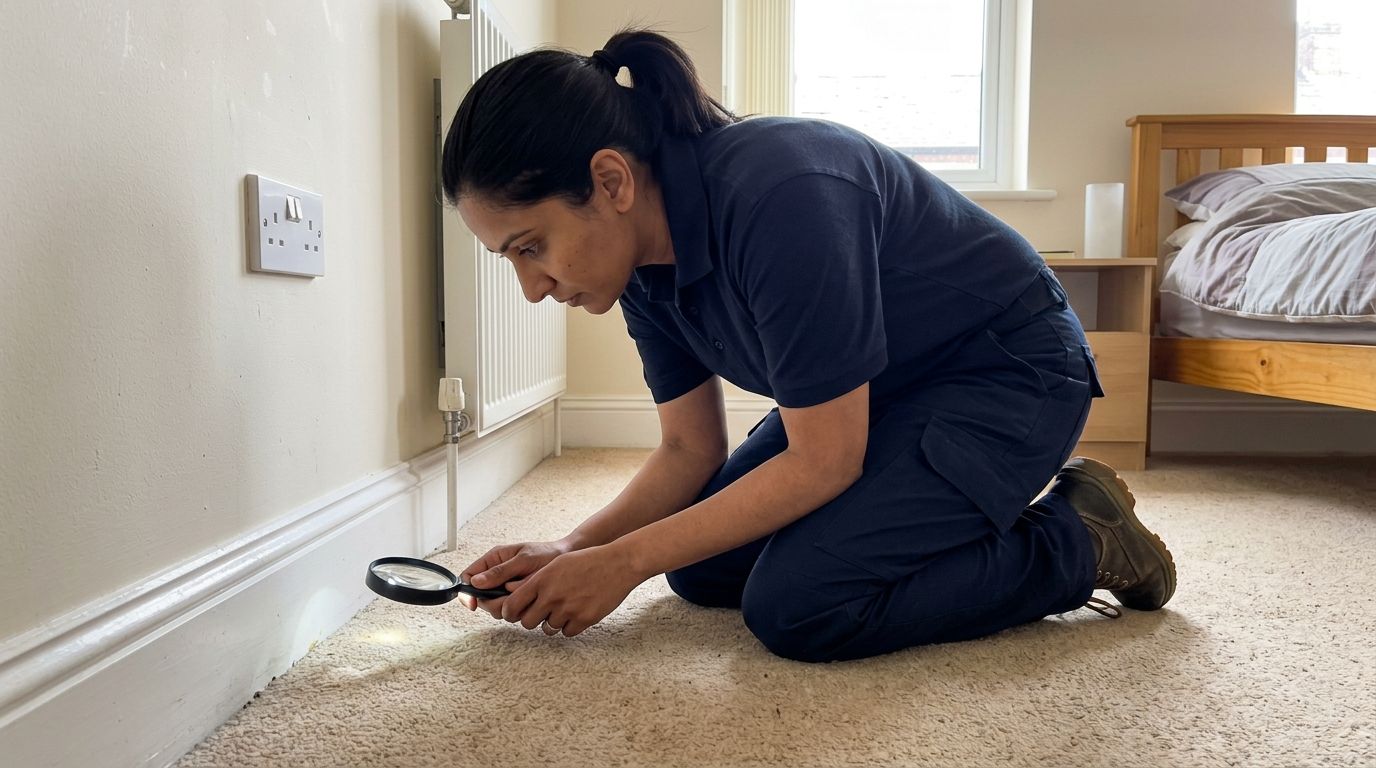
Manchester Pest Solutions treats carpet beetles in houses and flats across Manchester and Greater Manchester. We identify the larvae, find where they're breeding, often an old bird's nest in the loft, then treat carpet edges, floorboard gaps and wardrobes, usually with one follow-up visit. Call or message us and we'll offer the earliest slot we have, often the same day.
How do I know it’s carpet beetles?
Most people find the larvae long before they see a beetle. These are woolly bears: short, plump grubs up to about 5 mm long, striped light and dark brown and covered in bristly hairs. They shy away from light, so they turn up when you shift a chest of drawers or empty the bottom of a wardrobe.
Other signs worth looking for:
- thin patches or ragged holes in a wool carpet, worst along the skirting and under furniture that never moves;
- holes along the folds of woollens, felt, silk or fur that have been packed away;
- tiny empty skins, like hollow brown husks, shed each time a larva moults;
- small, round, mottled beetles on windowsills in late spring and summer, trying to get out to the flowers;
- an itchy rash of little red bumps, which can come from the larvae’s hairs rather than any bite.
Fine silky webbing or little cases on the fabric point to clothes moths instead. The two often share a house, and our moth removal service works in much the same way.
Why do carpet beetles turn up in Manchester homes?
Carpet beetle larvae live on keratin, the tough protein in wool, feathers, fur and hair, and on dead insects too, and older houses hide a lot of both. Most of Levenshulme is two-up two-down terraces built in the 1880s, Chorlton’s late-Victorian core includes big houses long since split into flats, and Burnage has streets of 1930s semis. Victorian terraces often have suspended timber floors, so decades of fluff settle between the boards, while fitted wool carpets run under wardrobes nobody moves.
The loft is the usual starting point. Sparrows, starlings and pigeons nest under eaves and loose slates, and an old nest full of feathers, droppings and dead insects makes a perfect nursery. An empty wasp nest, or the dead flies that pile up over winter, does the same job. The larvae then wander down along the joists and through ceiling gaps into bedrooms and airing cupboards. In some terraces the roof space isn’t fully divided at the party wall, so the source can be next door’s loft. Clearing a loft for a conversion or new insulation can also disturb an old nest and send larvae into the rooms below.
Then there’s the season. Adult beetles are about from late spring into summer, fly in through open windows and lay their eggs in dark corners. The larvae then feed slowly, often for a year or more, and warmth speeds them up, so a centrally heated house through a damp Manchester autumn suits them fine. That’s often when people first notice them, as the winter jumpers come out of storage.
What happens when you call us about carpet beetles?
Send us a photo first, ideally of a larva stuck to clear tape. Woolly bears, moth caterpillars and bed bug skins can look alike, and knowing which it is means we bring the right kit. We’ll ask which rooms are affected, who’s at home, including pets and anyone with asthma, and whether we can get into the loft.
On the visit, our first job is finding where they’re breeding, not spraying wherever you spotted one. We check carpet edges, under furniture, floorboard gaps, wardrobes, the airing cupboard and, where it’s safe, the loft and eaves. If there’s an old bird’s nest, we’ll tell you whether it can come out now or has to wait. Before treating a roof space we also check for bats: they and their roosts are protected by law and many insecticides harm them, so at any sign of them we leave that space until specialist advice has been taken through Natural England or the Bat Conservation Trust’s helpline.
You’ll get a short prep list too, covering hoovering, clearing the floor and washing, freezing or bagging clothes from affected wardrobes.
We then apply a professional residual insecticide where larvae hide and feed: carpet edges, under furniture, floorboard gaps, wardrobe and cupboard bases, and loft boards if they need it, never your clothes or bedding. Sticky insect monitors go in the worst rooms, so we can both see whether anything is still moving at the follow-up.
Is carpet beetle treatment safe for children and pets?
Yes, when it’s done properly and you follow our instructions. We ask about babies, children, pets, pregnancy and asthma when you book. Children and pets stay out of treated rooms until surfaces are dry, usually a couple of hours, and we’ll give you the exact time for the product used. Fish tanks need covering with the pumps off, because products that kill insects harm fish, and caged birds and reptiles are best moved to another room. Cats can be more sensitive than dogs to some insecticides, so tell us if you have one.
Plenty of the work isn’t chemical at all. Hot washing, freezing and a good hoover with the crevice tool do much of the heavy lifting, and in a nursery we lean on those first. The larvae don’t bite or spread disease, but if a child has itchy patches that won’t settle, mention it to your pharmacist or GP.
How many visits does carpet beetle treatment take?
Usually two: an inspection and treatment, then a follow-up a few weeks later. The second visit matters because eggs and larvae tucked deep in floorboard gaps or under gripper rods can survive the first round. We check the monitors, look along the edges again and re-treat anywhere still active.
Several affected rooms, or a loft nest that can’t come out until it’s empty, can add a visit. Seeing the odd larva for a week or two afterwards is normal, as they leave their hiding places and cross treated surfaces. If you’re still finding live ones after the follow-up, tell us.
How do I stop carpet beetles coming back?
- Every couple of weeks, hoover the places nobody sees: carpet edges, under beds and sofas, and wardrobe floors. Empty the cylinder outside.
- Put woollens, furs and special outfits away clean, in sealed bags or lidded boxes. Larvae prefer fabric with sweat or food on it.
- Check the loft each autumn, when nests are empty: clear old nests and dead insects, and get gaps at the eaves closed. If pigeons are nesting in the roof or under solar panels, our pigeon proofing service can help.
- Look over second-hand rugs, vintage clothes and feather cushions before they come indoors.
- If your loft has sheep’s wool insulation, ask the installer whether it was treated against insects.
When does DIY stop being enough?
A few larvae on a windowsill, or one jumper with a hole, is usually a hoover-and-wash job. Shop sprays and powders knock back what they touch, but they rarely reach the floorboard gaps and loft corners where most larvae live, and they do nothing about an old nest feeding the problem from above.
Call us if larvae keep turning up after a month of regular hoovering, if there’s damage in more than one room, if you’ve found them in the loft, or if wool carpets and heirlooms are at risk. Sticky insect monitors are fine to use yourself; they aren’t the rodent glue traps that the Glue Traps (Offences) Act 2022 restricts in England.
Mind the law on nests, too. Under the Wildlife and Countryside Act 1981 it’s an offence to take, damage or destroy the nest of any wild bird while it’s in use or being built, so a nest with eggs or chicks generally has to stay until the birds have gone.
Is it my landlord’s job or mine?
It depends where the beetles are coming from. If the source is the building itself, such as an old nest in the roof space or gaps at the eaves letting birds in, the repair usually falls under the landlord’s duty to keep the structure and exterior in repair under section 11 of the Landlord and Tenant Act 1985. A serious infestation can also count as a hazard under the Housing Health and Safety Rating System, and the Homes (Fitness for Human Habitation) Act 2018 lets tenants take action if a rented home isn’t fit to live in.
If the larvae are confined to your own wardrobe, it’s more often yours to sort, though your tenancy agreement may say otherwise. Either way, tell your landlord or letting agent in writing, with photos and dates. In a converted house where every flat shares one loft, the whole building needs looking at, not one flat.
We’ll work with tenants, landlords and agents alike, and our written note of what we found and treated helps whoever ends up paying.
What happens when you call us
- 1
Send us a photo
Call or message us with what you've found. A photo of a larva or beetle, or one stuck to clear tape, tells us whether it's carpet beetle, moth or something else before we visit. We'll ask about children, pets and asthma too.
- 2
Find the source
We check carpet edges, under beds and furniture, floorboard gaps, wardrobes, drawers and the airing cupboard, then the loft and eaves where we can get in safely, looking for old nests and for any sign of bats before anything is treated up there.
- 3
Get the rooms ready
You'll get a short prep list: hoover the edges and under furniture, empty the cylinder outside, clear the floor, and wash, freeze or bag up the clothes from affected wardrobes so nothing goes back into an untreated space.
- 4
Treatment
A professional residual insecticide goes along the carpet edges, under furniture, into floorboard gaps and onto wardrobe and cupboard bases, never onto clothes or bedding. We leave sticky insect monitors in the worst rooms and tell you when it's safe to go back in.
- 5
Follow-up visit
A few weeks later we check the monitors and the edges again and re-treat anywhere still active, to catch larvae that were tucked too deep for the first round to reach.
- 6
Keeping them out
We leave a written note of what we found and treated, plus practical advice on old nests, gaps at the eaves and storing woollens, so the beetles don't simply move back in next year.
How many visits? Usually two visits: an inspection and treatment, then a follow-up a few weeks later. An infestation spread across several rooms, or a source in the loft that has to wait until a bird's nest is empty, can add a visit.
Carpet Beetle Treatment: questions people ask us
What are the small hairy brown grubs on my carpet?
Almost certainly carpet beetle larvae, usually called woolly bears. They're short and plump, up to about 5 mm long, striped light and dark brown and covered in bristles, with little tufts at the back end. You'll find them along skirting boards, under beds and in the bottom of wardrobes, because they avoid light and feed on wool, feathers, hair and fluff. Each one moults several times, so empty husk-like skins are another giveaway. If you're not sure, put one on clear sticky tape and send us a photo, and we'll tell you what it is before anyone books a visit.
Can carpet beetles bite you?
No. The adult beetles feed on pollen and nectar, and the larvae eat fibres, not people. What the larvae can do is irritate the skin: their tiny barbed hairs give some people an itchy rash of small red bumps, often on the arms, neck or legs after sitting on a carpet or wearing a jumper that's been in storage. It's easy to mistake for bed bug or flea bites, so check the mattress seams too. If a rash doesn't settle, have a word with your pharmacist or GP.
How can I tell carpet beetle damage from moth damage?
Look for silk. Clothes moth caterpillars spin fine webbing and little tube-shaped cases on the fabric, and you may see small buff-coloured moths that scuttle rather than fly in a dark wardrobe. Carpet beetle larvae leave no webbing; instead you'll find the bristly larvae themselves and their shed skins, with scattered, ragged holes. Both go for wool, both hide in the same dark corners, and plenty of Manchester homes have both at once. Our inspection checks for both, and our moth removal service uses much the same approach.
Where are carpet beetles coming from in my house?
Usually from somewhere you haven't looked for a while. Old bird nests in the loft or under the eaves are the classic source, along with empty wasp nests and the dead flies that collect in roof spaces. Indoors, they breed in the fluff between floorboards, under the edges of fitted carpets, in airing cupboards and in boxes of stored clothes. The adult beetles also fly in through open windows in late spring and summer. In some terraces and converted houses, the source can even be a neighbour's loft on the other side of the party wall.
Will carpet beetles eat synthetic carpets and clothes?
Pure synthetics such as nylon and polyester aren't food for them, so a fully synthetic carpet is much less at risk. Blends are a different story: the larvae will chew through a wool-mix carpet, or a synthetic item stained with food or sweat, to get at what they can digest. Wool, silk, fur, feathers, felt and leather are their favourites, along with pet hair and the fluff that builds up under beds and sofas. That's why putting clothes away clean, in sealed bags or boxes, makes such a difference.
Do I need to throw away my clothes or carpet?
Rarely. Most clothes can be saved with a hot wash where the label allows, ideally 60°C, or by sealing them in a bag and leaving them in the freezer for a couple of weeks, then shaking and brushing them out. Dry cleaning suits delicate items. Carpets can usually be treated where they are; only badly damaged sections, or a cheap rug that's riddled, are worth replacing. If you do throw something out, bag it tightly first so larvae don't drop out on the way to the bin.
Is carpet beetle treatment safe with a baby or pets in the house?
Yes, with sensible precautions. The insecticide goes onto carpet edges, floorboard gaps and the bases of wardrobes, never onto clothes, bedding or cot mattresses, and everyone stays out of treated rooms until it's dry, usually a couple of hours. Fish tanks need covering with the pumps off and caged birds or reptiles moving to another room, and we'd like to know about cats, as they can be more sensitive to some products. In nurseries we rely on hoovering, hot washing and freezing wherever we can.
I rent my home. Should my landlord pay for carpet beetle treatment?
It depends on the cause. If the beetles are breeding in an old nest in the roof, or birds are getting in through damaged eaves, that's tied to the building, and repairs to the roof and exterior usually sit with your landlord. If the larvae are confined to your own wardrobe and clothes, it's more often yours to sort, although your tenancy agreement may say otherwise. Report it in writing with photos and dates. Check Manchester City Council's website for current pest control services and charges.
When is the best time to clear old bird nests out of the loft?
Autumn and winter, once the nests are empty. The Wildlife and Countryside Act 1981 makes it an offence to take, damage or destroy the nest of any wild bird while it's in use or being built, so a nest with eggs or chicks generally has to be left alone. Most garden birds have finished by late summer, but pigeons can nest in any month, so check first. Bat roosts are protected too, so if you spot droppings that might be from bats, stop and ask the Bat Conservation Trust's helpline before clearing anything.
Carpet Beetles near you
- Levenshulme
- Chorlton
- Didsbury
- The Heatons
- Fallowfield
- Manchester City Centre
- Salford
- Stockport
- Bury
- Cheadle & Cheadle Hulme
- Eccles & Swinton
- Longsight
- Prestwich & Whitefield
- Sale
- Stretford
- Urmston
- Withington
- Wythenshawe & Northenden
- Ashton-under-Lyne
- Bramhall & Hazel Grove
- North Manchester (Blackley, Moston & Harpurhey)
- Rusholme & Moss Side
Last updated: