Manchester Pest Solutions is a local team dealing with mice in houses, flats and rented homes across Manchester and the Greater Manchester towns around it. We find how they're getting in, treat with children and pets in mind, then block the gaps. Call or message us and we'll offer the earliest slot we have, often the same day.
How do I know it’s mice?
Most people hear mice before they see them: a light scratching in the ceiling or behind the kitchen units, usually after bedtime. Then the droppings turn up, small, dark and rod-shaped with pointed ends, about the size of a grain of rice, along the back of a worktop or in the cutlery drawer.
Other things to look out for:
- nibbled packets of cereal, rice or pet food, often with a tiny hole in one corner;
- a musty, slightly ammonia-like smell in a cupboard you rarely open;
- shredded paper or loft insulation pulled into a loose nest;
- greasy smudges along skirting boards where mice run the same route every night.
Much bigger droppings point to rats, which our rat control page covers. A sandy-brown mouse with big ears and eyes, especially if you back onto a park, may be a wood mouse in for the winter; the treatment is much the same.
Why am I suddenly getting mice?
Timing is the big one. Mice look for warmth and food as the nights draw in, so autumn and winter are when most people first notice them. If you’re reading this in late autumn, you’re right on schedule.
Manchester’s housing does the rest. More than a quarter of households in the city live in terraced houses, according to the 2021 Census, and many of those terraces are Victorian or Edwardian. Most of Levenshulme’s went up around 1880 to 1890 as two-up two-downs with back entries. Homes of that age often have suspended timber floors, airbricks that have lost their grilles, and over a century of pipes and cables pushed through the brickwork. A mouse needs a gap of only around 6 mm, roughly the width of a pencil, and the void under the floor can link several houses along a row.
The 1930s and 1940s semis along Kingsway in Burnage have their own weak spots: cavity walls mice can travel inside, gaps around newer boiler flues and waste pipes, and sheds or garages full of bird seed and pet food. In Chorlton and West Didsbury, lots of big Victorian houses have been split into flats, with shared floor voids, service risers and communal bin stores. If one flat has mice, the next one often does too.
Then there’s disturbance. A neighbour’s new kitchen or a big demolition job, such as the long rebuild of the university’s Fallowfield campus, can push mice from one place into the next. Student streets can get busy in autumn too, when new tenants arrive with extra rubbish and food. A 2015 local news report said Manchester City Council had logged around 6,000 mice reports in a year, over a thousand of them from Moss Side and Fallowfield together.
What happens when you call us?
You tell us what you’ve seen or heard, and we’ll ask who’s at home: children, pets, anyone elderly or unwell. Then we’ll offer the earliest slot we have, often the same day, whether you’re in a city flat or one of the Greater Manchester towns around it.
On the first visit we take our time. We look under kitchen plinths, behind the cooker and washing machine, round the pipes under the sink, under the stairs, in the loft and along the outside walls. We want to know where they’re living and how they’re getting in. Mice rarely stray far from the nest, so knowing their runs matters more than counting them.
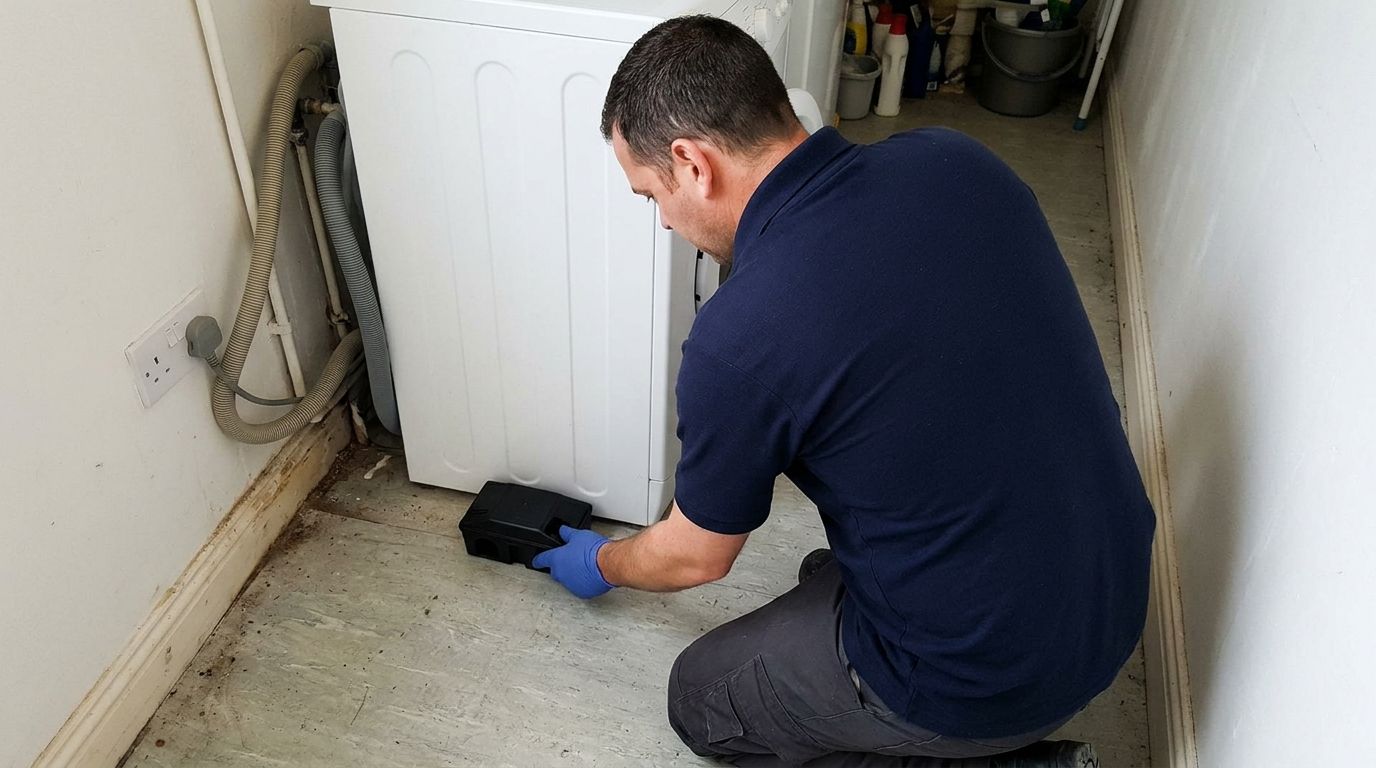
Then we choose the treatment. In many homes, especially those with cats or dogs, we start with snap traps inside covered boxes along the runs. Where activity is heavier or hidden in floor voids, we may add bait, always locked inside tamper-resistant boxes. Professional rodenticides are only sold to trained, certified users under the UK’s stewardship scheme, which expects them to be used only for as long as they’re needed, so we don’t leave poison down “just in case”.
We start sealing gaps on the first or second visit. If something needs a builder, or your landlord, we’ll tell you plainly and show you where.
Is it safe with children and pets in the house?
Yes, when it’s done properly. It’s the part we’re fussiest about. Nothing goes down loose. Traps sit inside covered boxes so little fingers and curious paws can’t reach the trigger, and any bait is locked in a box that’s fixed down or tucked out of reach. We’ll show you where every box is and take them all away at the end.
Cats deserve a special mention. A cat that eats a poisoned mouse can be harmed, so we lean on trapping in homes with cats and collect any mice we find. If you think a pet has eaten bait, ring your vet straight away; we leave the product details with you whenever we use it.
Clean up droppings carefully, because they can carry bacteria such as salmonella. Wear gloves, spray with disinfectant first, wipe up with kitchen roll and bag it. Don’t sweep or vacuum droppings dry, which sends dust into the air.
How many visits will it take?
Most homes need two or three visits about a week apart. The first covers the survey, treatment and as much proofing as we can do there and then. The second checks the traps or boxes, removes any mice, looks for fresh droppings and finishes the sealing. A third sometimes confirms everything is quiet. Long-standing problems, converted flats or mice next door as well can take longer, because the job isn’t finished until the way in is closed.
How do you stop mice coming back?
Proofing makes the difference. Once the mice have gone, the gap they used is an open invitation to the next lot. The usual suspects in Manchester homes are holes around pipes under the sink and behind the washing machine, gaps where floorboards meet the skirting in older terraces, airbricks with broken grilles, gaps around boiler flues and meters, and the bottoms of back doors and garage doors.
Food matters too. Keep cereal, pet food and bird seed in sealed tubs, clear crumbs from behind the toaster and cooker, lift pet bowls at night and keep bin lids shut. If you share a wall with someone who’s also had mice, a friendly word is worth it; treating one house in a row often just moves the problem along.
When does DIY stop being enough?
If you’ve seen one mouse and a few droppings, a couple of snap traps set against the wall along the run, baited with a dab of peanut butter, will sometimes sort it. Shop-bought mouse poison comes in small packs with strict label rules about indoor use in bait stations, and it’s easy to end up with mice dying under the floorboards.
Skip glue traps altogether: using one on a mouse has been an offence in England since 2024 unless you hold a Natural England licence. Ultrasonic plug-ins and peppermint oil are harmless, but mice soon ignore them.
It’s time to call us if you’re still finding fresh droppings after a fortnight, you can hear them in the walls or ceiling, they’re in more than one room, there’s a baby or someone vulnerable at home, or you can’t work out how they’re getting in. For other household pests, see our domestic pest control page.
Is it my landlord’s job or mine?
Often it’s shared, and the detail depends on your tenancy. In most lets in England, section 11 of the Landlord and Tenant Act 1985 makes the landlord responsible for keeping the structure and exterior in repair, so if mice are getting in through holes in walls, broken airbricks or gaps around pipes, fixing that usually falls to them. Under the Homes (Fitness for Human Habitation) Act 2018 a rented home must also be fit to live in, and the council can assess a serious infestation under the Housing Health and Safety Rating System, which has a hazard covering domestic hygiene, pests and refuse.
Tenants are generally expected to keep the home reasonably clean and report problems quickly, in writing. If an infestation is clearly down to how the home has been kept, a landlord may ask the tenant to pay. In a shared student house or a block of flats, the landlord or managing agent is usually best placed to arrange treatment across the building, and we’re glad to work with them. We’ll write up what we found so everyone is working from the same facts.
For a café, takeaway or corner shop, mice are a food-safety matter. Food hygiene law expects proper pest-control procedures, an environmental health officer is likely to ask to see your records, and councils have powers under the Prevention of Damage by Pests Act 1949 to require owners or occupiers to deal with rats and mice. Our commercial pest control service is set up for exactly that.
What happens when you call us
- 1
Tell us what you've noticed
Call or message us with what you've seen or heard and where. We'll ask about children, pets and anyone vulnerable at home, and we'll offer the earliest slot we have, often the same day.
- 2
A proper look round
We check under kitchen plinths, behind the cooker and washing machine, around pipes and meters, under the stairs, in the loft and along the outside walls to find where mice are living and getting in.
- 3
Treatment chosen for your home
Snap traps inside covered boxes, locked tamper-resistant bait boxes, or both, placed along the runs and out of reach. We show you where every box is before we leave.
- 4
Sealing the way in
We block the gaps we found with materials mice can't easily chew through, such as wire wool packed in with sealant, metal mesh, airbrick covers and door brush strips, and flag anything that needs a builder or your landlord.
- 5
Follow-up and clear-up
We come back to check traps and boxes, remove any mice, look for fresh droppings and finish the proofing, then take all our equipment away once things have gone quiet.
How many visits? Most homes need two or three visits about a week apart: survey and treatment first, then one or two follow-ups to check, finish proofing and collect everything. Long-standing problems, converted flats or mice shared with next door can take longer.
Mice Control: questions people ask us
Why have I suddenly got mice when I've never had them before?
It's usually a mix of season and opportunity. Mice move indoors as the weather turns in autumn, and a new gap is often all it takes: a pipe replaced under the sink, a broken airbrick, or a neighbour having building work done or clearing out a shed. In terraces and converted flats, mice can also travel through shared floor voids, so the problem may have started next door. It doesn't mean your home is dirty. Mice find warmth and crumbs in the tidiest of kitchens.
If I've seen one mouse, are there more?
Probably. Mice are shy and mostly active at night, so the one you spot is rarely the only one. A female can start breeding at around six weeks old and have a new litter every few weeks when food and warmth are easy to find, which is how a couple of mice in October can become a busy kitchen by Christmas. Fresh droppings in more than one room, or scratching in the ceiling as well as the kitchen, suggest they're already well settled.
Is mouse treatment safe with a baby, a cat or a dog at home?
Yes, with the right set-up. We ask who lives with you before we choose anything. Traps go inside covered boxes, and any bait is locked inside tamper-resistant boxes placed out of reach, so there's nothing loose for a crawling baby or a nosy dog to find. In homes with cats we lean on trapping, because a cat that eats a poisoned mouse can be harmed. We show you where everything is and take it all away when we're done.
Do I have to tell my landlord about mice, and who pays?
Tell them as soon as you can, ideally in writing. In most lets in England the landlord is responsible for the structure and exterior of the home, so gaps in walls, broken airbricks and holes around pipes are usually theirs to fix, and a serious infestation can make a home unfit to live in. If the problem is clearly down to how the home has been kept, a landlord may ask the tenant to pay. Your tenancy agreement should say more, and we're happy to deal with your landlord or letting agent directly.
Will Manchester City Council get rid of mice for me?
Check Manchester City Council's website for current pest control services and charges. Check your council's website for current pest control services and charges. The other Greater Manchester councils each do things their own way, so check your council's website for current terms and waiting times before you book. Whoever you use, ask whether sealing the entry points is part of the job, because treatment without proofing rarely lasts.
How can I tell mouse droppings from rat droppings?
Size is the giveaway. Mouse droppings are around 3 to 6 mm long, about the size of a grain of rice, thin with pointed ends, and scattered along the routes mice run. Rat droppings are much bigger, roughly 1 to 1.5 cm, thicker and blunter, and often found in small clusters. If you're finding the bigger kind, or you've spotted burrows in the garden or gnawing on wood, have a look at our rat control page, because the approach is different.
Can I use glue traps for mice?
No. Since 2024 it has been an offence in England to use a glue trap to catch a rodent without a licence from Natural England, and those are only for trained pest controllers in exceptional cases, to protect public health or safety where nothing else will work. Glue traps cause a slow, distressing death and can catch birds or pets by accident. If you're tackling a mouse or two yourself, snap traps set inside covered boxes are quicker, more humane and legal.
Do ultrasonic plug-ins or peppermint oil keep mice away?
Not in any lasting way. A mouse may avoid an ultrasonic device for a few days, but they soon get used to it, and the sound doesn't travel through walls, cupboards or furniture to where they're nesting. Peppermint oil smells lovely to us and might move a mouse along a shelf, but it won't shift a nest. Neither does anything about the gap they're using. Your money is better spent on sealed food tubs and some wire wool and sealant for the gaps around pipes.
Will the mice come back after you've finished?
Sealing the way they got in makes it far less likely, which is why we spend as much time on proofing as on treatment. What nobody can control is a new hole appearing, such as a plumber cutting through a wall, or mice arriving from next door along a shared floor void in an older terrace. If you see fresh droppings after we've finished, tell us straight away. A quick check early on is much easier than starting again in the middle of winter.
Mice near you
- Levenshulme
- Fallowfield
- Chorlton
- Didsbury
- Manchester City Centre
- Salford
- Stockport
- Bury
- Cheadle & Cheadle Hulme
- Eccles & Swinton
- The Heatons
- Longsight
- Prestwich & Whitefield
- Sale
- Stretford
- Urmston
- Withington
- Wythenshawe & Northenden
- Ashton-under-Lyne
- Bramhall & Hazel Grove
- North Manchester (Blackley, Moston & Harpurhey)
- Rusholme & Moss Side
Last updated: