Manchester Pest Solutions deals with mice in Salford homes, including terraces in Seedley and Langworthy, Pendleton flats and student houses near the university. We trace the runs and the way in, use covered traps or locked boxes out of reach of children and pets, come back to check, then seal the gaps. Call or message us to book.
Why do Salford terraces get mice when the weather turns?
In a Salford terrace, the explanation for mice usually sits under the floor. The terraced streets of Seedley and Langworthy belong to the city’s industrial expansion, when some districts were packed at roughly 80 houses per acre, and many houses built then still sit on suspended timber floors over a void that runs beneath several neighbours. Regeneration since the 2000s has changed parts of these streets, but a new kitchen or boiler doesn’t close the space under the floorboards. A mouse living beneath one house can feed in three.
As autumn sets in, mice that spent the summer in yards, sheds and park edges look for warmth. That’s when the scratching starts behind the kitchen plinth or above the ceiling, usually late at night, followed by droppings along the back of the worktop.
Mice in tower blocks and apartment towers
Living high up doesn’t keep mice out. Pendleton’s tower blocks and the Quays apartment buildings, some of them 16 to 20 storeys, are threaded with service risers, pipe boxing and cable runs linking one floor to the next. Mice climb those routes with ease and often nest in warm spots near boilers, behind kitchen units or inside the boxing around soil stacks. In a block, the colony may be centred on a bin store or a void several flats away, so treatment inside one home helps, but the building’s managers need to look at shared areas too.
When we visit a flat, we check under the kitchen units, behind appliances, around pipes where they pass through walls and floors, and inside any boxed-in risers we can safely open. We’ll tell you plainly which gaps are inside your home and which belong to the block.
Student houses near the university
Shared houses close to the University of Salford give mice plenty to work with: food stored in several cupboards, bins that nobody owns and doors left open while people come and go. The council’s guide for students says it simply: rubbish attracts rats and other vermin, so lids stay shut and bags don’t sit beside the bin. With more than 19,000 students at the university, lots of new households set up kitchens each autumn, just as mice are hunting for somewhere warm.
If you rent, tell your landlord or letting agent in writing as soon as you spot droppings. Proofing usually falls to them, and it’s far easier to sort while it’s a few mice rather than a settled family.
How a mice job runs in a Salford home
You tell us what you’ve seen or heard and who lives with you, children and pets included, and we’ll offer the earliest slot we have, often the same day.
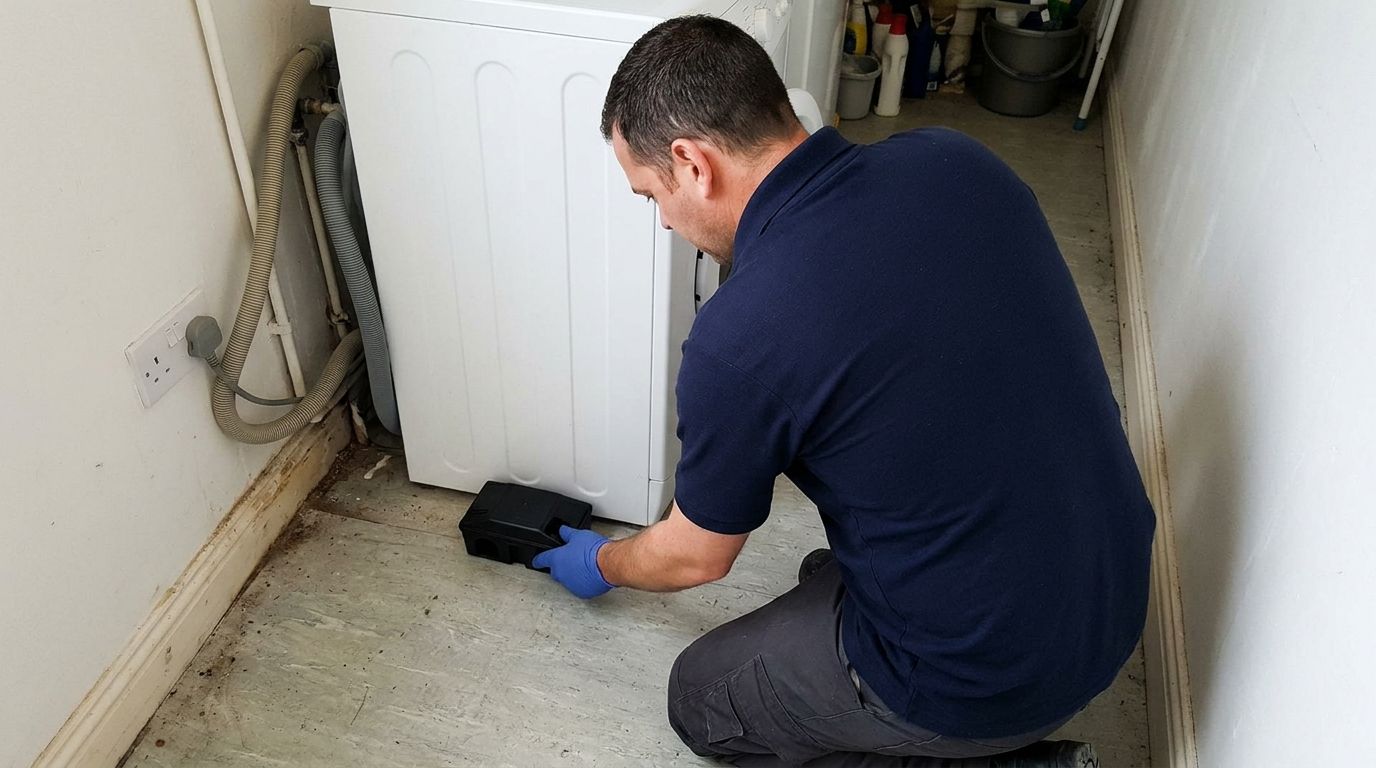
On the first visit we look for runs, droppings and entry points: under kitchen plinths, behind the cooker and washing machine, along skirting boards, under the stairs and in the loft. In a terrace we pay close attention to airbricks and the floor void; in a flat, to pipe entries and boxing. Covered traps go along the runs, and where activity is heavy we may add bait in locked, tamper-resistant boxes placed out of reach. Homes with cats get a trapping-first approach.
Most homes need two or three visits about a week apart. We check and clear the traps, look for fresh droppings and finish the proofing, then take everything away once it’s quiet.
Keeping them out of a Salford home
The fixes depend on the building. In a terrace, swap any airbricks with broken grilles for mesh-backed ones, and fill holes around pipes under the sink and behind the washing machine with wire wool bedded in sealant. In a flat, ask the managing agent or housing provider to check the boxing and risers on your floor. Near the big parks, keep bird seed and pet food in sealed tubs and shut shed and garage doors through the autumn. And if next door has mice too, a word over the yard wall can save you both a repeat visit.
What we tend to find in Salford
- Terraces in Seedley and Langworthy, part of Housing Market Renewal work since the 2000s, still share party walls and under-floor voids along each row, so mice often move between houses rather than in from the street.
- In Pendleton's high-rise flats and the 16- to 20-storey apartment towers at Salford Quays, mice can travel between floors through service risers and pipe boxing, so the source may be several flats away.
- Homes beside Buile Hill Park, Peel Park and Kersal Dale can see wood mice that spent the summer outdoors moving into sheds and kitchens once autumn arrives.
What happens when you call us
- 1
Tell us what you've noticed
Call or message us with what you've seen or heard and where. We'll ask about children, pets and anyone vulnerable at home, and we'll offer the earliest slot we have, often the same day.
- 2
A proper look round
We check under kitchen plinths, behind the cooker and washing machine, around pipes and meters, under the stairs, in the loft and along the outside walls to find where mice are living and getting in.
- 3
Treatment chosen for your home
Snap traps inside covered boxes, locked tamper-resistant bait boxes, or both, placed along the runs and out of reach. We show you where every box is before we leave.
- 4
Sealing the way in
We block the gaps we found with materials mice can't easily chew through, such as wire wool packed in with sealant, metal mesh, airbrick covers and door brush strips, and flag anything that needs a builder or your landlord.
- 5
Follow-up and clear-up
We come back to check traps and boxes, remove any mice, look for fresh droppings and finish the proofing, then take all our equipment away once things have gone quiet.
Mice Control in Salford: your questions
Our renovated Langworthy terrace still gets mice. Didn't the work seal it up?
Not necessarily. Modernising a house rarely closes every gap. New kitchens, boilers and cabling often mean fresh holes through old brickwork, and if those weren't made good they become doorways. A renovated house may also share an under-floor void and party walls with neighbours whose homes are in a different state, so mice can arrive from inside the row rather than from outdoors. We check the floor void, airbricks and service entries, seal what we find on your side, and tell you if the route seems to be coming from next door.
We're in a Pendleton tower block. Will the housing provider treat the whole building?
It's worth asking, because in a high-rise the mice you see are often coming from a shared space such as a bin store, a service riser or a void behind the kitchens that links several flats. Report it to your landlord or housing provider in writing, and mention it if neighbours have seen them too. Treating communal areas is normally their decision. We can still treat inside your flat, seal the pipe entries and boxing we can reach, and give you notes to pass on so the building side gets looked at.
We back onto Buile Hill Park. Are these house mice or wood mice?
It could be either. Wood mice live in parks, hedges and long grass through the summer and often move into sheds, garages and kitchens when the weather turns. They're a warmer, golden-brown colour, with prominent eyes, large ears and a tail about as long as the body, and they tend to leap rather than scurry. House mice are greyer, with smaller eyes, and stay indoors once settled. The treatment and proofing are much the same for both, and homes next to Salford's bigger green spaces tend to see more autumn arrivals.
Who should book mice treatment in a shared student house?
Usually the landlord or letting agent, so tell them in writing as soon as you find droppings, with photos and a note of where you found them. Gaps around pipes, under kitchen units and at the back door are normally theirs to fix, and the whole house needs including for treatment to work. In the meantime, get everyone to move dry food into sealed tubs, take turns with the bins and keep the lids closed, as the council's student guide asks. If your landlord books us, we can talk the whole household through it on the first visit.
Why have I suddenly got mice when I've never had them before?
It's usually a mix of season and opportunity. Mice move indoors as the weather turns in autumn, and a new gap is often all it takes: a pipe replaced under the sink, a broken airbrick, or a neighbour having building work done or clearing out a shed. In terraces and converted flats, mice can also travel through shared floor voids, so the problem may have started next door. It doesn't mean your home is dirty. Mice find warmth and crumbs in the tidiest of kitchens.
If I've seen one mouse, are there more?
Probably. Mice are shy and mostly active at night, so the one you spot is rarely the only one. A female can start breeding at around six weeks old and have a new litter every few weeks when food and warmth are easy to find, which is how a couple of mice in October can become a busy kitchen by Christmas. Fresh droppings in more than one room, or scratching in the ceiling as well as the kitchen, suggest they're already well settled.
Is mouse treatment safe with a baby, a cat or a dog at home?
Yes, with the right set-up. We ask who lives with you before we choose anything. Traps go inside covered boxes, and any bait is locked inside tamper-resistant boxes placed out of reach, so there's nothing loose for a crawling baby or a nosy dog to find. In homes with cats we lean on trapping, because a cat that eats a poisoned mouse can be harmed. We show you where everything is and take it all away when we're done.
More help in Salford
Last updated: