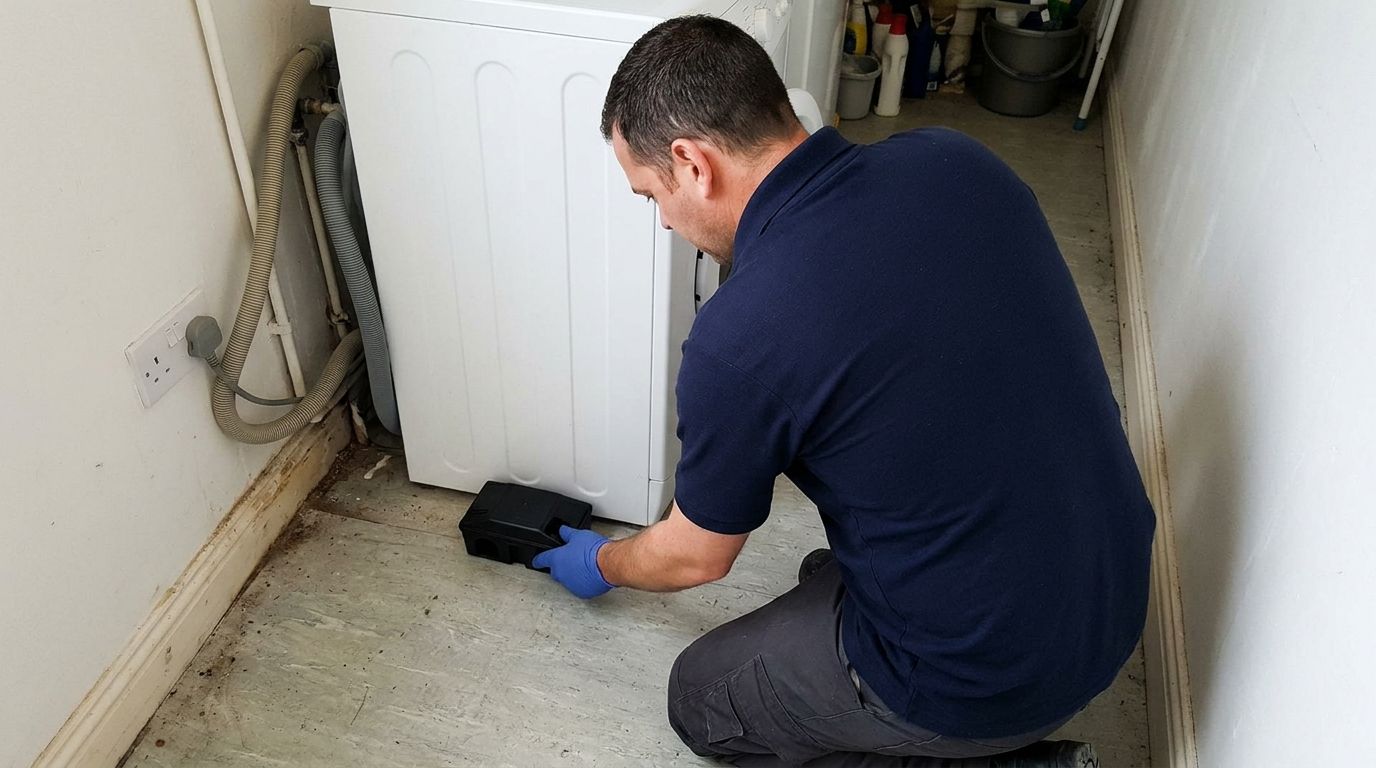
Manchester Pest Solutions clears mice from Didsbury homes, from West Didsbury flats and conversions to East Didsbury semis. We survey, set covered traps or locked bait boxes where children and pets can't reach them, then seal the gaps, usually over two or three visits. Call or message us and we'll offer the earliest slot we have.
Why are mice so stubborn in West Didsbury conversions?
Just over a third of households in the Didsbury West ward live in purpose-built flats, and nearly one in five in a house split into flats or bedsits. A converted house was built as one home, so nothing underneath really separates the units. The space below the floorboards, the boxing that carries pipes between storeys and the void behind fitted kitchens all link up. Mice use those routes every night, and clearing them out of one flat often just sends them upstairs.
That’s why, in a conversion, one of our first questions is who else lives in the building. If the landlord or managing agent can open up the hall, the loft and the neighbouring flats, the job is far more likely to stay done. More than four in ten Didsbury West households rent privately, so we’re used to arranging access through letting agents and sending a written summary to everyone involved.
Semis and lofts in East Didsbury
The Didsbury East ward is mostly semi-detached and mostly owner-occupied, with plenty of families. Here mice usually arrive from outside. The common ways in are a gap around the kitchen waste pipe, a cracked airbrick, the hole where a newer boiler flue goes through the wall, and garages or sheds where bird seed, dog food or garden cushions make an easy larder and bed. Once inside the walls, mice can climb to the loft, which is why scratching overhead at bedtime is so often the first sign. The house joined to yours may well have the same problem.
Parks, woodland and mice coming in for winter
Didsbury’s green spaces sit right among the houses. Fog Lane Park lies in the north, Didsbury Park and Marie Louise Gardens are between the streets, and Fletcher Moss and Stenner Woods run down to the Mersey. Gardens backing onto any of them can see wood mice heading indoors in autumn, alongside the house mice that live with people all year round. If the scratching starts as the nights draw in, you’re not imagining it.
How does a mouse job run in a Didsbury home?
It starts with a call or message about what you’ve seen or heard, which rooms, and who lives with you, including children, cats and dogs. Once we know that, we’ll offer the earliest slot we have, often the same day.
The first visit is a proper survey. In a conversion that means the shared spaces as well as your own kitchen; in a semi it means the outside walls, the garage and the loft as well as under the units. Then we set covered snap traps along the runs, and where activity is heavier or hidden under floors, locked tamper-resistant bait boxes placed out of reach. If there’s a cat in the house, trapping does most of the work. We show you every box before we leave.
Proofing starts on the first or second visit, using materials that suit the building, which matters on a street of listed or conservation-area houses. Expect two or three visits with roughly a week between them. A conversion where several flats are involved can take a little longer, and we won’t call it finished while fresh droppings are still turning up.
Keeping mice out of a Didsbury home
If your block or converted house has a shared bin area, keep the lids shut and ask the agent to deal with overflowing bins quickly, because spilled food draws mice to the building. After any building or repair work, look at where new pipes and cables pass through the walls, as a gap the width of a pencil is enough. In East Didsbury garages and sheds, keep seed and pet food in lidded metal or hard plastic tubs. In rented flats, report any hole you find to your landlord in writing so it gets fixed properly. If you also hear something heavier under the floor, our rat control page explains what to look for next.
What we tend to find in Didsbury
- More than half of Didsbury West households live in flats or converted houses, where mice travel between homes through shared floor voids and pipe boxing, so we often need to check the flats above and below.
- Most Didsbury East households live in semis, where mice usually get in low down around waste pipes, airbricks and boiler flues, then climb inside the walls to the loft.
- Gardens near Fog Lane Park, Didsbury Park, Marie Louise Gardens or Fletcher Moss can see wood mice coming indoors in autumn as well as house mice.
- Much of West Didsbury lies in the Albert Park conservation area, so any proofing on the outside of the house is kept small, neat and in keeping with the building.
- More than four in ten Didsbury West households rent privately, so many mouse jobs there involve the landlord or letting agent as well as the tenant.
What happens when you call us
- 1
Tell us what you've noticed
Call or message us with what you've seen or heard and where. We'll ask about children, pets and anyone vulnerable at home, and we'll offer the earliest slot we have, often the same day.
- 2
A proper look round
We check under kitchen plinths, behind the cooker and washing machine, around pipes and meters, under the stairs, in the loft and along the outside walls to find where mice are living and getting in.
- 3
Treatment chosen for your home
Snap traps inside covered boxes, locked tamper-resistant bait boxes, or both, placed along the runs and out of reach. We show you where every box is before we leave.
- 4
Sealing the way in
We block the gaps we found with materials mice can't easily chew through, such as wire wool packed in with sealant, metal mesh, airbrick covers and door brush strips, and flag anything that needs a builder or your landlord.
- 5
Follow-up and clear-up
We come back to check traps and boxes, remove any mice, look for fresh droppings and finish the proofing, then take all our equipment away once things have gone quiet.
Mice Control in Didsbury: your questions
I'm in a converted flat in West Didsbury. Do the other flats need treating as well?
Usually, yes. A house that has been split into flats still shares one set of floor voids, pipe runs and roof space, and mice move through them freely. If only your flat is treated, they tend to move upstairs or next door and come back once the traps are gone. Ask your landlord or managing agent to arrange access to the shared hall, the loft and any other flats, and we'll plan the visit so the whole building is covered at once.
There's scratching in the loft of our East Didsbury semi. How are mice getting up there?
Most often they come in low and climb. A gap around a waste pipe at the back of the house, a broken airbrick or an unsealed hole where a cable or flue passes through the wall lets them inside, and from there they climb to the roof space. Loft insulation and stored boxes then make a warm nest. We check the outside walls at ground level first, then the loft, and seal the route at both ends.
We back onto one of Didsbury's parks. Are these wood mice or house mice, and does it matter?
It could be either. Wood mice are sandy brown with big eyes and ears, a pale belly and a long tail. They live outdoors in places like Fog Lane Park, Didsbury Park and Stenner Woods and move into sheds, garages and kitchens as the weather cools. House mice are a duller grey-brown with smaller eyes and ears, and they're happy indoors all year. Treatment and proofing are much the same for both, but wood mice are a strong hint that the way in is at ground level from the garden.
Our semi shares a wall with next door. Will they need treating too?
Often, yes. Most households in Didsbury East live in semis, and the two halves share a party wall, which isn't always complete up in the loft, and sometimes pipe boxing or a run of drains as well, so mice can pass between them. If you hear them at bedtime and next door hasn't mentioned it, it's worth a word over the fence. We can treat and proof your side on its own, but the result lasts longer when both houses are checked, and we're happy to look at next door's ways in on the same visit if they'd like.
Why have I suddenly got mice when I've never had them before?
It's usually a mix of season and opportunity. Mice move indoors as the weather turns in autumn, and a new gap is often all it takes: a pipe replaced under the sink, a broken airbrick, or a neighbour having building work done or clearing out a shed. In terraces and converted flats, mice can also travel through shared floor voids, so the problem may have started next door. It doesn't mean your home is dirty. Mice find warmth and crumbs in the tidiest of kitchens.
If I've seen one mouse, are there more?
Probably. Mice are shy and mostly active at night, so the one you spot is rarely the only one. A female can start breeding at around six weeks old and have a new litter every few weeks when food and warmth are easy to find, which is how a couple of mice in October can become a busy kitchen by Christmas. Fresh droppings in more than one room, or scratching in the ceiling as well as the kitchen, suggest they're already well settled.
Is mouse treatment safe with a baby, a cat or a dog at home?
Yes, with the right set-up. We ask who lives with you before we choose anything. Traps go inside covered boxes, and any bait is locked inside tamper-resistant boxes placed out of reach, so there's nothing loose for a crawling baby or a nosy dog to find. In homes with cats we lean on trapping, because a cat that eats a poisoned mouse can be harmed. We show you where everything is and take it all away when we're done.
More help in Didsbury
Last updated: