Manchester Pest Solutions deals with wasp nests on houses and flats across Sale, including Brooklands, Sale Moor and Ashton upon Mersey. We follow the flight line back to the nest, make sure it isn't bees, then treat the entrance with an approved dust, usually from the ground, with children and pets kept indoors. Call or message us to book.
What draws wasps to Sale’s roofs and sheds?
Each spring, queens that have spent the winter tucked into sheds, lofts and wall cavities wake up and go looking for a dry, sheltered space with a small way in. Sale’s roofs span everything from railway-era villas built after 1849 to interwar semis and 1970s estates, and each kind ages in its own way. That variety means we rarely know exactly where a nest is until we’ve watched the flight line, but there are patterns worth knowing.
What do we find on different Sale roofs?
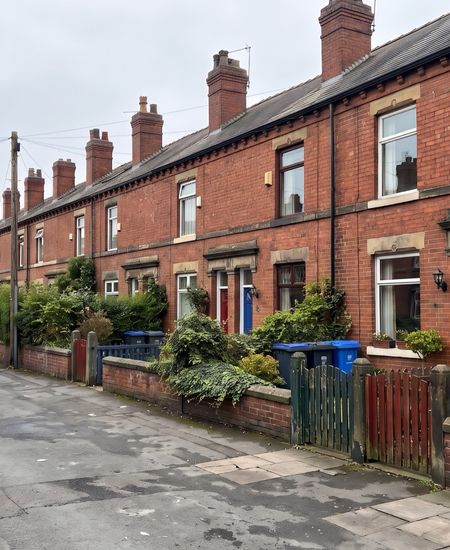
The villas of Sale Moor and Brooklands, and the terraces built in the same era, date back more than a hundred years. On these, a nest usually sits behind a slipped slate, a weathered bargeboard on a gable, or the flashing where a chimney meets the roof. Many of the bigger houses are now split into flats, and the roof void is often shared, so wasps flying in above one flat’s window may be nesting over another flat’s ceiling.
The 1930s semis that line so many Sale streets have long soffits along the eaves and small roofs over their bay windows. Wasps make good use of the gap where a soffit board has shrunk away from the wall. On the 1970s estates in Ashton upon Mersey and the east of the town, fascia and soffit boards are now around fifty years old where the originals survive, and replacements that weren’t sealed properly leave the same kind of opening.
Sheds, garages and bird boxes get their share too, particularly in gardens near Worthington Park, Walton Park or the edges of Sale Water Park, where weathered fences and fallen branches supply wood for nest paper, and the planting brings in the flies and caterpillars that workers hunt for their larvae. Holes in lawns and banks are worth watching as well, because common wasps will move into an old mouse burrow.
What happens on the day?
Ring or message with a rough idea of where the wasps are disappearing, whether that’s at gutter height or up by the chimney, and say if anyone at home has had a bad reaction to a sting or is very young or frail. If you can take a photo without getting close, it lets us rule out bees before we set off. We’ll offer the earliest slot we have, often the same day.
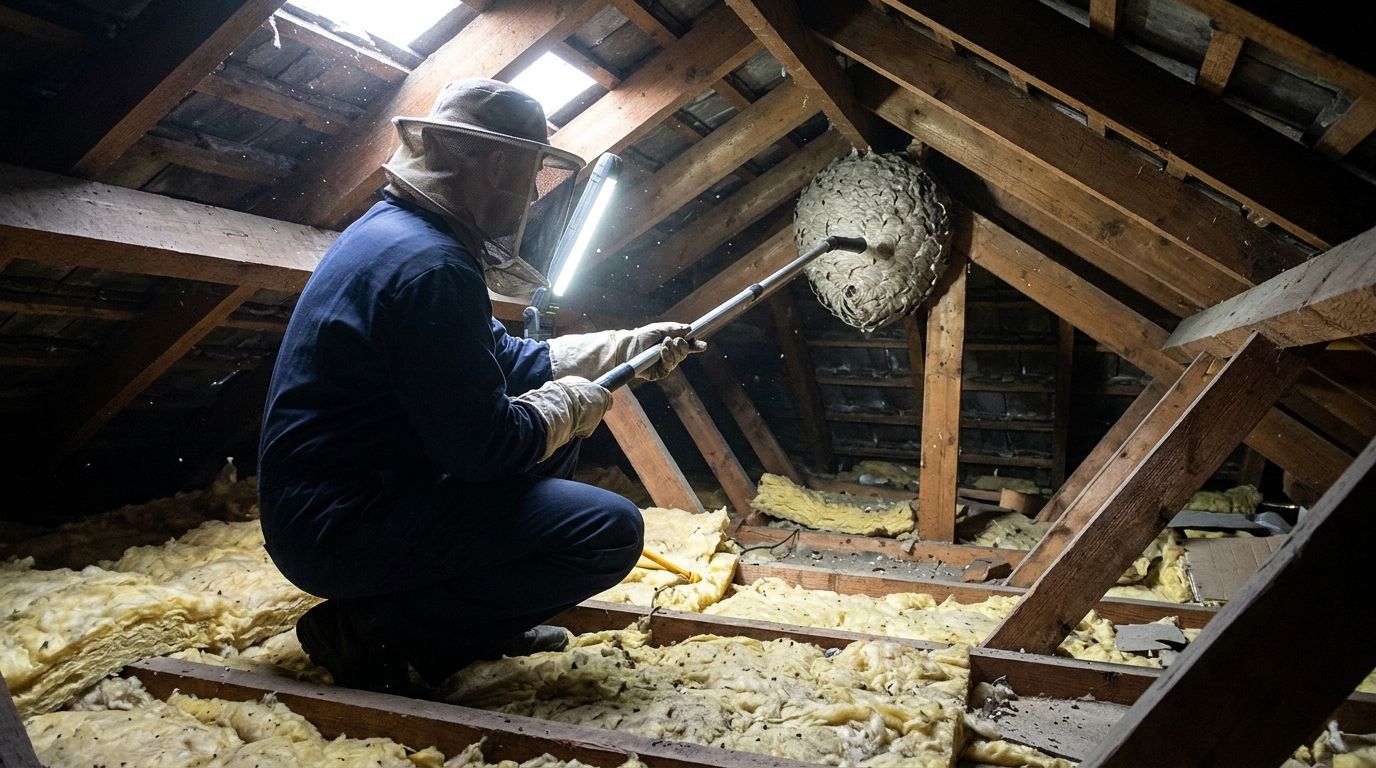
Once we arrive, the first job is simply watching. On a semi the entrance usually gives itself away within minutes; a taller villa with several roof levels, or a terrace whose loft runs along the row, can take a little patience. When we’re sure of the spot, we puff a professional dust into the hole on a long lance, normally standing in the garden or on the pavement, and the wasps carry it inside themselves. Keep children and pets in while we’re working, and the windows near the nest closed. For the rest of that day, steer everyone, cats especially, clear of the treated spot.
If the hole is on a shared part of a converted building, the person who manages the roof has to give permission, and we can contact the managing agent ourselves.
Is it worth treating a nest this late in the year?
Often not. By the end of October most colonies in Sale are close to collapse: the workers slow down and die as the cold sets in, while this year’s young queens have already flown off to hibernate somewhere sheltered. If you’ve only just spotted a nest in the loft and there’s no traffic at the entrance on a mild afternoon, it has probably finished by itself. A dozy wasp on a bedroom curtain at this time of year is more likely a queen looking for a winter hiding place than a sign of a busy nest overhead.
Once it has gone quiet, a dead nest hanging from a rafter near the hatch can be bagged and binned. Anything behind a wall or under the tiles is best left where it is.
How can you stop a nest next year?
Use the quiet months to shut the door the queen used. Have slipped slates refitted, get split soffits repaired and fit fine mesh over vents. If you rent, report the gap to your landlord in writing, because the roof and outside walls are normally theirs to look after. Come April and early May, glance under the shed roof and inside any bird boxes: a new nest at that stage is about the size of a walnut, with only the queen looking after it. And if the insects turn out to be fluffy and round rather than smooth and striped, read our bees and bumblebees page before calling anyone.
What we tend to find in Sale
- On Sale's Victorian terraces and villas, nests most often sit behind a slipped slate, a weathered bargeboard or the flashing where a chimney meets the roof.
- Sale's many 1930s semis give queens long runs of soffit and the small roofs over bay windows, and a nest there can usually be traced from the garden by watching the flight line.
- Where the original fascia and soffit boards survive on the 1970s estates in Ashton upon Mersey and east Sale, they are now around fifty years old, and warped or poorly refitted boards leave the narrow gaps wasps look for.
- Where a big Victorian house has been divided up, the roof void normally belongs to the whole building, so treatment is usually the freeholder's or managing agent's call even if only one flat has wasps at the window.
- Gardens near Worthington Park, Walton Park and the green edges of Sale Water Park give workers insects to hunt and old timber to chew, so sheds, bird boxes and holes in lawns are worth checking there too.
What happens when you call us
- 1
Tell us what you're seeing
Where the wasps are flying in, roughly how high it is, and whether anyone at home is allergic to stings. A photo of the entrance from a safe distance helps us check it's wasps, not bees.
- 2
Finding the way in
We watch the flight line first, because where you see wasps isn't always where they go in. It might be a slipped slate, a split soffit, an airbrick or a hole in the lawn.
- 3
Treating the nest
An approved insecticidal dust goes into the entrance, usually with an extension lance from the ground. Wasps walking in and out carry it deep into the nest for us.
- 4
Aftercare, in plain English
Before we leave we show you where we've treated, which windows to keep shut, and where children and pets should steer clear of until the next day.
- 5
Checking it's worked
Wasps stay busy for a few hours, then tail off over a day or two. If they're still flying in steadily after that, let us know and we'll come back for a look.
- 6
Taking the nest away, if it's in the way
Dead nests are never reused, so most are left in place. If one is in a shed, garage or bird box you use, we can remove it once it has gone quiet.
Wasp Nest Removal in Sale: your questions
It's late October and wasps are still crawling around our Sale loft. Is the nest still active?
Probably not for much longer. Colonies die off in autumn, so slow, sleepy wasps indoors at this time of year are usually dying workers or new queens looking for somewhere to hibernate. Watch the entrance outside on the next mild afternoon. If wasps are landing and vanishing every few seconds, the nest is still going and worth treating if it's beside a window or door. If not, leave it and plan to seal the gap over the winter.
The nest is in the shared roof of our converted flat. Can you treat it without the freeholder?
We can treat an entrance we can reach from your own flat or garden, but if it's on a communal part of the building, whoever is responsible for the roof needs to agree first. That's usually the freeholder or managing agent. If wasps are getting inside your flat, tell them in writing that it's urgent, and we're happy to ring them to explain what we've seen and arrange access to the right spot.
Will Trafford Council remove a wasp nest from my home?
Many councils run a pest control service for residents, but what is covered, who can book and the charges all vary and can change, so check the council's own pest control pages before you book. If you rent from a council or housing association, report the problem to your landlord first. If you would rather book a private firm, call or message us and we'll offer the earliest slot we have.
Something is flying in and out of a hole in our lawn near the canal. Is it wasps?
It might be. Common wasps often take over an old mouse burrow, and in summer you'll see a steady stream using one hole. Round, furry bees using a single hole are probably bumblebees, which we'd leave alone. Lots of tiny holes with little volcano-shaped mounds of soil in spring usually mean mining bees, which are harmless and gone within a few weeks. Send us a photo taken from a safe distance and we'll identify it for you.
Can I get a wasp nest removed for free in Manchester?
Usually not. Councils have no legal duty to deal with wasps, so it comes down to what each one chooses to offer. Check Manchester City Council's website for current pest control services and charges. Check your council's website for current pest control services and charges. Its website sets out the current pest list and booking conditions, so read those before you book. Other Greater Manchester councils set their own rules, and housing association tenants should ask their landlord first.
Can I just leave the nest until winter?
Often, yes. If the nest is somewhere nobody goes, such as high on a gable or at the bottom of a big garden, it will die off on its own once the frosts arrive, and wasps never reuse an old nest. It's worth treating if the entrance is next to a back door, a window you open, a path, a pram or a play area, or if anyone at home is allergic. Remember that wasps get more bad-tempered in late summer, so a nest that's tolerable in June can be a real nuisance by September.
How do I know if it's wasps or bees?
Wasps are bright yellow and black, smooth and shiny, with a narrow waist, and they fly straight in and out of a small gap. Bumblebees are round and furry; the tree bumblebee, with a ginger body, black middle and white tail, loves bird boxes and eaves. Honeybees are slimmer, golden brown and slightly fuzzy, and a swarm hanging from a branch is almost always honeybees. We don't routinely treat bees. Send us a photo if you're unsure, and see our bees and bumblebees page for what to do instead.
More help in Sale
Last updated: