Manchester Pest Solutions treats wasp nests at homes in Prestwich and Whitefield, including tall villa roofs near Prestwich Village and terraces round Lily Hill Street. We check it's wasps rather than bees, dust the entrance from the ground with a long lance and show you where children and pets should keep clear. Call or message us to book.
Why do wasps pick Prestwich and Whitefield homes?
A queen coming out of hibernation in spring is after three things: a dry, dark hollow behind a small gap, wood she can scrape and chew into paper, and plenty of small insects to feed her first grubs. Both towns supply all three. Heaton Park stretches over more than 600 acres along Prestwich’s eastern side, the River Irwell runs down the western side with Prestwich Forest Park out that way too, and the Metrolink line cuts a green strip through the middle. Gardens near any of them have hedges, fence posts and insect life on the doorstep, and the houses supply the gaps.
By late summer a single colony can hold thousands of workers. That’s also when they turn their attention from grubs to sugar, which is why August barbecues and the café tables on Bury New Road suddenly get very popular with wasps.
What do we tend to find on each kind of house?
On Prestwich’s Victorian villas, the nest is often high: under the eaves of a tall gable, behind a fascia board near the top of the house, or in the roof void over a back wing. Those entrances usually sit well above head height, which is exactly where DIY sprays and ladders become a bad idea. Our extension lance lets us treat most of them from the ground.
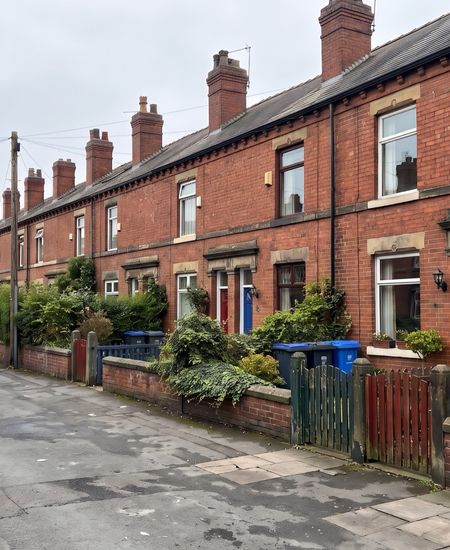
Whitefield’s mill-era terraces around Lily Hill Street and Nipper Lane tend to give wasps a way in through a slipped slate, crumbling pointing at the eaves or a gap at the top of the party wall. The nest can sit over next door’s ceiling even though the wasps fly in past your bedroom window. The larger houses near Ringley Road and Park Lane may have garages, sheds or summer houses as well, and a quiet outbuilding makes a tempting nest site.
On the Hillock, Elms and Victoria estates, nests turn up in much the same places as on any family home: at the roof edge, in airbricks and vents, and in garden sheds. If you rent, check with your landlord before booking, because access to the roof or a repair afterwards may be theirs to arrange.
Is it definitely wasps?
Check before booking anyone. Bury Council’s pest service covers wasps but won’t treat bees, and we don’t routinely treat bees either. Wasps are smooth and bright yellow and black; bumblebees are round and furry. A photo taken from a safe distance settles it, and our bees and bumblebees page explains the options if it turns out they’re bees.
How does the visit run?
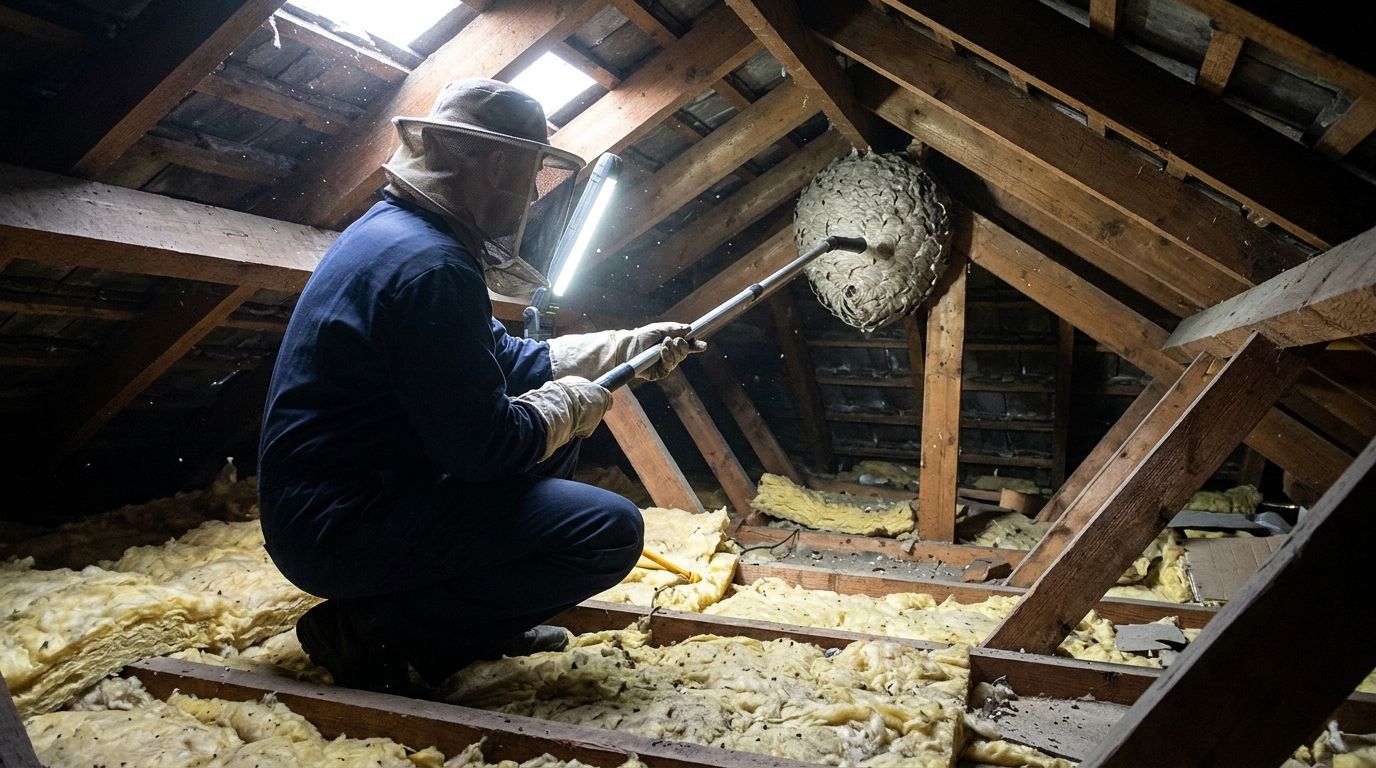
Tell us where the wasps are going in, roughly how high it is, whether anyone at home is allergic to stings, and whether there are children or pets about. We’ll offer the earliest slot we have, often the same day. When we arrive we watch the flight line before doing anything, because on a shared terrace roof the busy spot isn’t always the true entrance. Then we puff an approved insecticidal dust into the hole, usually from the ground with the lance. Returning wasps carry it inside, activity drops over a day or two, and most jobs are done in one visit. If the nest is still busy after that, let us know and we’ll come back.
Keeping children and pets safe for the rest of the day
While we treat, keep children and pets indoors with the windows on that side closed. Afterwards, keep everyone away from the treated spot until the next day, and keep cats in if they have a favourite windowsill near the nest. Please don’t block the hole, because trapped wasps may chew their way into the house instead. Everywhere else, the day carries on as normal.
Making next year less likely
Wasps build a fresh nest every year, but a sheltered gap that suited one queen can suit the next. Once this year’s colony has died off in the cold, get the slate refitted, the pointing redone or fine mesh fitted over the vent. Through late summer, keep bin lids shut and pick up windfall fruit, especially if you live near the food places on Bury New Road. For anything else that turns up under the roof, our domestic pest control page is the place to start.
What we tend to find in Prestwich & Whitefield
- Prestwich's Victorian merchant villas have tall gables and long runs of eaves and fascia, so nest entrances are often well above head height and need our extension lance rather than a ladder.
- On the mill-era terraces around Lily Hill Street and Nipper Lane, a slipped slate or worn pointing at the eaves is a common way in, and the nest itself can end up over a neighbour's ceiling.
- Gardens near Heaton Park, which covers more than 600 acres, and the green spaces along the Irwell valley give queens fence wood for nest paper and plenty of insects to feed the grubs.
- Bury Council's paid pest service treats wasps but lists bees among the pests it won't deal with, so a photo to rule out bumblebees is worth taking before anyone books.
- The run of cafés and bars on Bury New Road puts out sugary waste that draws foraging wasps in late summer, so lidded bins matter in the village centre as much as at home.
What happens when you call us
- 1
Tell us what you're seeing
Where the wasps are flying in, roughly how high it is, and whether anyone at home is allergic to stings. A photo of the entrance from a safe distance helps us check it's wasps, not bees.
- 2
Finding the way in
We watch the flight line first, because where you see wasps isn't always where they go in. It might be a slipped slate, a split soffit, an airbrick or a hole in the lawn.
- 3
Treating the nest
An approved insecticidal dust goes into the entrance, usually with an extension lance from the ground. Wasps walking in and out carry it deep into the nest for us.
- 4
Aftercare, in plain English
Before we leave we show you where we've treated, which windows to keep shut, and where children and pets should steer clear of until the next day.
- 5
Checking it's worked
Wasps stay busy for a few hours, then tail off over a day or two. If they're still flying in steadily after that, let us know and we'll come back for a look.
- 6
Taking the nest away, if it's in the way
Dead nests are never reused, so most are left in place. If one is in a shed, garage or bird box you use, we can remove it once it has gone quiet.
Wasp Nest Removal in Prestwich & Whitefield: your questions
Does Bury Council remove wasp nests, and is it free?
The council's pest control team does treat wasps, but it isn't free for anyone: every domestic treatment carries a charge. Households receiving Council Tax Support can get a reduced rate on most treatments by booking over the phone, and there's a charge if the technician can't get access on the day. Bees aren't on its list at all. You book and pay online, so check the council's website for the current terms. If you'd rather have us out instead, we'll offer the earliest slot we have.
The nest is right up near the top of our Prestwich villa's gable. Can you reach it from the garden?
Usually, yes. Our extension lance is made for high entrances, and most gables, fascias and upper eaves on the big Victorian houses can be dusted from the garden or the drive without scaffolding or climbing onto the roof. If the entrance is hidden behind a chimney stack, a bay or a conservatory roof, we'll look at the angles and explain the options before we start. Late in the season, if the wasps aren't bothering anyone, leaving that nest to die off can be a fair choice.
Our Whitefield terrace shares a roof line with next door, and the wasps go in on their side. What now?
We'll need your neighbour's agreement before treating an entrance on their side of the gutter, so have a word with them first. On older terraces the loft above the party wall isn't always sealed, which is why wasps on their side can still end up in your bedroom. Once they're happy, we treat from outside, so neither loft needs opening. Ask them to keep children, pets and windows shut on that side for the afternoon, and you do the same.
Does living close to Heaton Park make a wasp nest more likely?
Not necessarily. Living near a big park means more insects and more fence wood about, but a queen still needs a sheltered gap to build in. What matters most is the house: a missing slate, a split soffit or an open vent. If you had a nest this year, get that gap closed over the winter. Keep an eye on sheds, bird boxes and outdoor storage in spring too, because a nest found while it's still small is much easier to deal with.
Can I get a wasp nest removed for free in Manchester?
Usually not. Councils have no legal duty to deal with wasps, so it comes down to what each one chooses to offer. Check Manchester City Council's website for current pest control services and charges. Check your council's website for current pest control services and charges. Its website sets out the current pest list and booking conditions, so read those before you book. Other Greater Manchester councils set their own rules, and housing association tenants should ask their landlord first.
Can I just leave the nest until winter?
Often, yes. If the nest is somewhere nobody goes, such as high on a gable or at the bottom of a big garden, it will die off on its own once the frosts arrive, and wasps never reuse an old nest. It's worth treating if the entrance is next to a back door, a window you open, a path, a pram or a play area, or if anyone at home is allergic. Remember that wasps get more bad-tempered in late summer, so a nest that's tolerable in June can be a real nuisance by September.
How do I know if it's wasps or bees?
Wasps are bright yellow and black, smooth and shiny, with a narrow waist, and they fly straight in and out of a small gap. Bumblebees are round and furry; the tree bumblebee, with a ginger body, black middle and white tail, loves bird boxes and eaves. Honeybees are slimmer, golden brown and slightly fuzzy, and a swarm hanging from a branch is almost always honeybees. We don't routinely treat bees. Send us a photo if you're unsure, and see our bees and bumblebees page for what to do instead.
More help in Prestwich & Whitefield
Last updated: